
- Admissions
-
Academics
- College of Arts & Sciences
- Pamplin School of Business Administration
- School of Education
- Donald P. Shiley School of Engineering
- School of Nursing
- Graduate School
- Library
- Provost
- Registrar
- Center for Entrepreneurship
- Garaventa Center
- Academic Advising
- Early Alert
- Fellowships & Grants
- Honors Program
- Majors & Minors
- Studies Abroad
- University Catalog: The Bulletin
- Air Force ROTC
- Army ROTC
-
Campus Life
- Arts & Culture
- Campus Ministry
- Counseling & Health Center
- Dining
- Housing & Residence Life
- International Student Services
- Moreau Center for Service & Leadership
- Portland, OR
- Public Safety
- Recreational Services
- Shepard Freshman Resource Center
- Student Activities
- Student Affairs
- Student Resources
- Sustainability
- Services
- Athletics
- About UP
- Home >>
- Campus Ministry >>
- Bell Tower Plaza >>
- Marian Garden
- Campus Ministry
- Chapel of Christ the Teacher
MSC 151 - 5000 N Willamette Blvd.
- Portland OR 97203
- 503-943-7131
- ministry@up.edu
Campus Ministry: Marian Garden
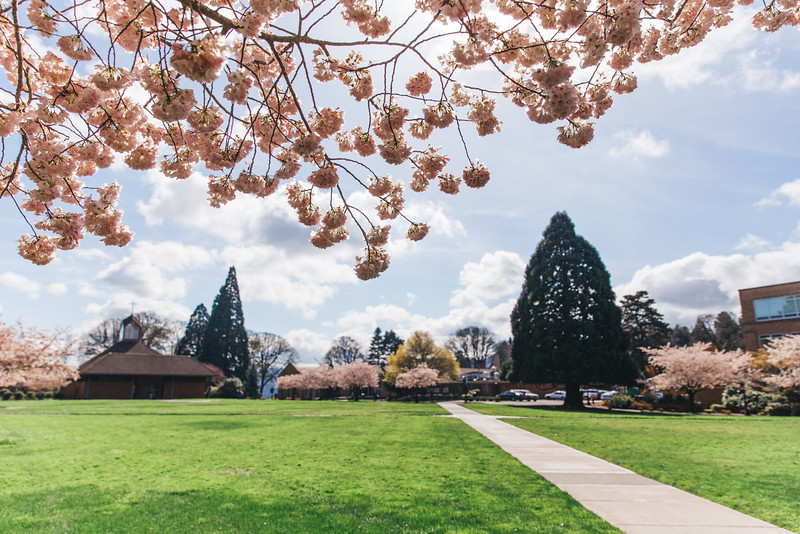
The garden in which the tower stands is dedicated to Mary and it rests as an invitation to prayer. “The Marian garden that surrounds the tower will draw us in, quiet our hearts, inspire contemplation, and comfort us,” said Father Beauchamp. All of the flowers and plants in the Marian garden of the plaza have a reference to Mary, Jesus or other elements of Christian tradition. Experiencing the flowers of the Marian garden can be an immersive experience of prayer.
The Marian garden was a gift to the University from that Galati family that quickly became a favorite place of prayer and respite for students, faculty and staff. The original garden (on the same site) incorporated the same Italian bronze of Mary, large stones and cherry trees. Their flowering coinsides each year with our celebration of Easter and the conclusion of the Spring semester.
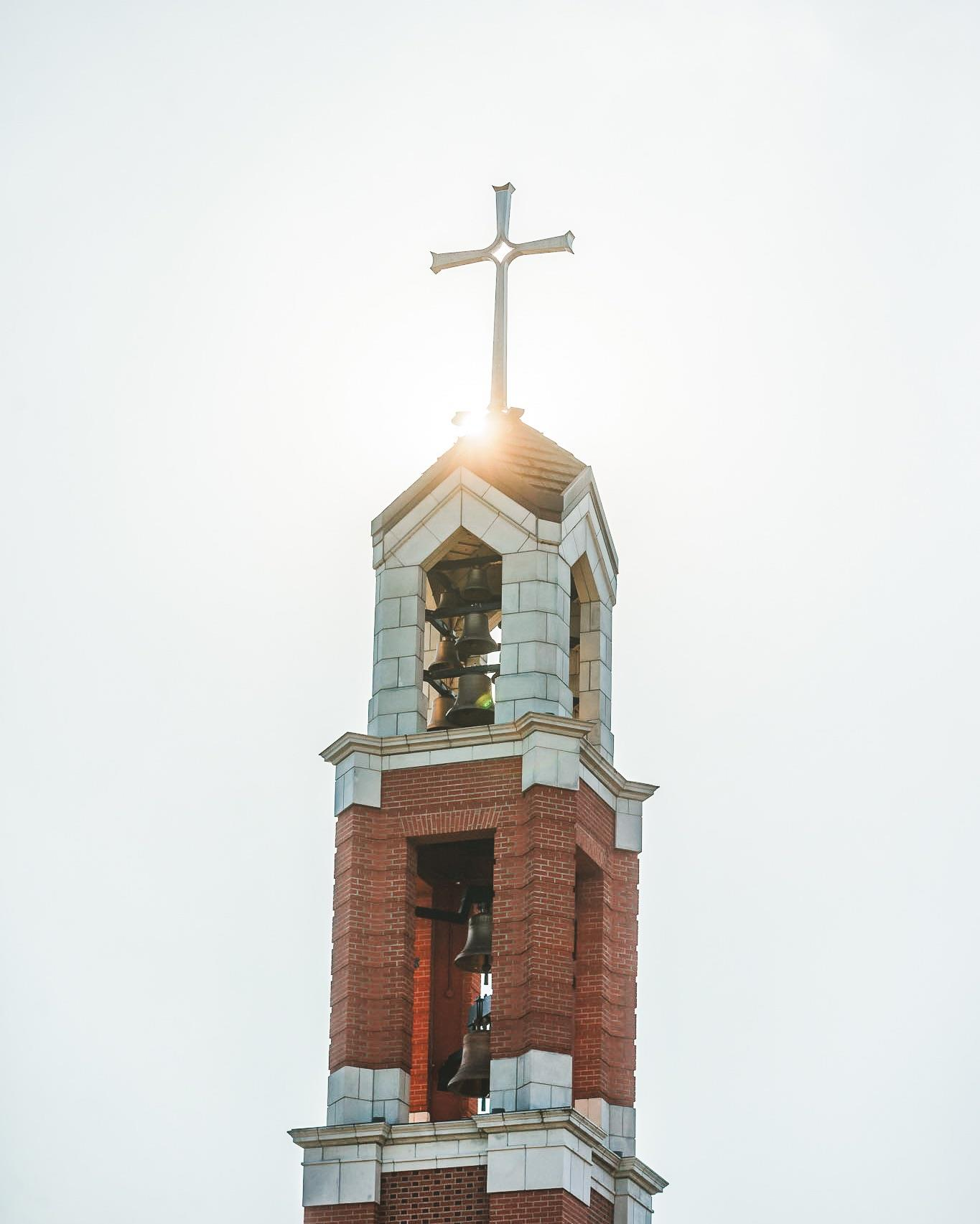
The advent of the bell tower allowed the garden to be redesigned as an even more restful meditative space. Among several changes to the previous garden configuration is the new location of the statue of the Madonna, now aligned with the Chapel's tabernacle. Emphasizing the role of both the Blessed Mother and tabernacle as carriers of Christ.
The image of a garden plays a fundamental role in the history of our salvation. God placed our forebears, Adam and Eve, in a garden and walked with them there in the cool of the evening. It was in this garden that they first sinned, tasting of the tree of knowledge of good and evil. This sin was confronted and overcome by Jesus in his decision in the garden of Gethsemane to remain faithful, even in the face of him impending suffering and death. This faithfulness was vindicated by God when Jesus was resurrected from the dead, emerging from his tomb in a garden. In fact, the first person to see the risen Lord, Mary Magdalene, mistook him first for a gardener. The garden is the setting for our fall and our redemption—full of life, the garden encapsulates all of creation and our salvation.
In medieval allegory, the sealed garden of Eden is also an image of Mary because it is self-contained (virgin), pure, abundant, and contained the tree of life, a typological reference to Jesus, whose death on a tree (cross) gives us all life. Early Christians had such a devotion to Mary that they saw her life reflected in the plants, even using flowers as illustrations for teaching about Mary and Jesus.
Central to the Marian garden is the bronze statue of Mary. Mary holds a lily, an ancient Christian symbol of purity. By design, the statue is placed directly outside of the space in the Chapel of Christ the Teacher that contains the tabernacle. Mary, having held Jesus in her body for nine months before he was born, is an image of the tabernacle (which holds the Real Presence of Jesus) and of us all, who bear Christ to the world. In Christian symbolism, Mary is seen as the new ark of the covenant. The original ark contained the ten commandments, the word of God articulated as a life-giving law to Moses and the people of Israel. Mary also contained the Word of God, Jesus Christ, who gives life to all people through his life, death and resurrection.
For an aerial rendering of the site and explanation of the various elements and plants as well as their symbolism please follow this link.
Praying with Mary
Mary’s role in the Christian faith is inseparable from her union with Jesus, and flows directly from that union. Mary is the best example we have of a faithful disciple—she gave herself completely to God’s will, devoted herself to her son’s life and work, and followed every prompting of the Holy Spirit. For these reasons, she is the mother of the Church.
The Church’s devotion to Mary is a very important part of our life of worship, and the devotion the Church shows to Mary is different from (and fosters) the adoration which we offer the Trinity.
The earliest Christians appealed to Mary because of her special role as the Mother of God. Through her union with Christ, Mary is concerned with bringing us all to new life in Christ. Because Mary is our spiritual mother, she continues to intercede for us from her place in heaven, and we rightfully ask her to pray for us in times of need.
In conversations about matters of faith on campus, often we hear of a discomfort with praying for Mary’s intercession on our behalf. The bishops of this nation articulate well the way the Church balances Mary’s intercession with Christ’s mediation in chapter 12 of the US Catholic Catechism for Adults:
This seems to be a mediating role that crosses a line set out in the First Letter to Timothy: “For there is one God. There is also one mediator between God and the human race, Christ Jesus, himself human who gave himself as a ransom for all” (1 Tim 2:5). So Jesus Christ is the one and only mediator. Jesus alone is the Savior.
But this does not deny the possibility that Christ would permit others to share in his mediating role. Here on earth we routinely ask others for prayers. Instinctively, we turn to holy people for their prayers because they seem nearer to God. Why would we stop asking saints for their prayers after they die? If we believe they are in heaven, would not their prayers be even more effective?
From the earliest times, Christians have sought Mary’s prayers and help. There has been the basic sense on the part of the Church that Mary continues in heaven to be concerned for the growth of all members of the Church in holiness and an intimate relationship with her Son.
-
- ministry@up.edu
- 503-943-7131
- Directions & Maps
- 5000 N. Willamette Blvd., Portland, OR 97203-5798
- © 2013 University of Portland, All Rights Reserved