
- Admissions
-
Academics
- College of Arts & Sciences
- Pamplin School of Business Administration
- School of Education
- Donald P. Shiley School of Engineering
- School of Nursing
- Graduate School
- Library
- Provost
- Registrar
- Center for Entrepreneurship
- Garaventa Center
- Academic Advising
- Early Alert
- Fellowships & Grants
- Honors Program
- Majors & Minors
- Studies Abroad
- University Catalog: The Bulletin
- Air Force ROTC
- Army ROTC
-
Campus Life
- Arts & Culture
- Campus Ministry
- Counseling & Health Center
- Dining
- Housing & Residence Life
- International Student Services
- Moreau Center for Service & Leadership
- Portland, OR
- Public Safety
- Recreational Services
- Shepard Freshman Resource Center
- Student Activities
- Student Affairs
- Student Resources
- Sustainability
- Services
- Athletics
- About UP
- Home >>
- Campus Ministry >>
- Bell Tower Plaza >>
- Bell Tower Plaza
- Campus Ministry
- Chapel of Christ the Teacher
MSC 151 - 5000 N Willamette Blvd.
- Portland OR 97203
- 503-943-7131
- ministry@up.edu
Campus Ministry: The Angelus
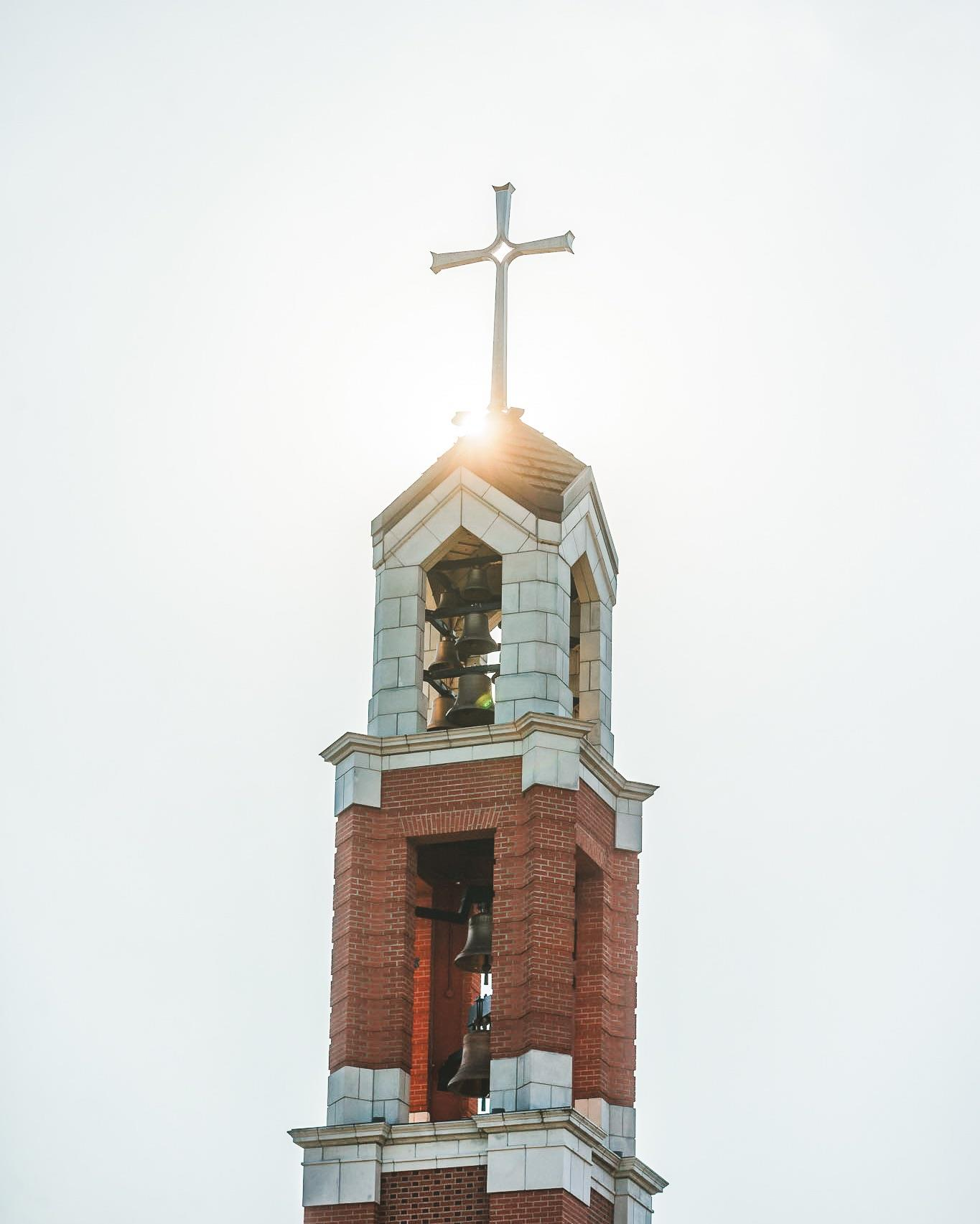
In the Christian faith, the tradition of ringing bells has its roots in monasteries, where bells were rung up to 12 times throughout the day and night to call monks to prayer. When they heard these bells ringing throughout the day, the faithful living in towns and cities near monasteries would stop what they were doing to join the prayer of the monks in spirit from wherever they were at the moment. In our Christian tradition, bells unify the community in prayer and sanctify the day with the awareness of God’s presence.
One specific prayer associated with the ringing of bells is called the Angelus, which is rung at 12 noon and 6 PM on campus. As the bells toll the Angelus, the prayers below are addressed to God through Mary. This devotion derives its name from the Latin version of the first phrase of the three prayers, “Angelus Domini” (“The angel of the Lord declared unto Mary”).
When the Angelus rings at noon on campus, we are invited to pause and remember the mystery of God’s love and presence in our lives and in this world at that very moment.
The Angelus Prayer
Following the ringing of the noon hour, the Angelus begins with three short strikes on the large bell. Following these strikes the following prayer is said:
The angel of the Lord declared unto Mary,
and she conceived of the Holy Spirit.
Hail Mary, full of grace,
the Lord is with you.
Blessed are you among women,
and blessed is the fruit of your womb, Jesus.
Holy Mary, Mother of God,
pray for us sinners,
now and at the hour of our death.
Amen.
Three more bells are rung:
I am the handmaid of the Lord. Let it be done to me according to your word.
Hail Mary, full of grace…
Three more bells are rung:
And the Word became flesh and dwelt among us.
Hail Mary, full of grace…
The large bell rings continuously as the following is said:
Pray for us, O Holy Mother of God, that we may be made worthy of the promises of Christ.
Pour forth, we beseech you, O Lord, your grace into our hearts;
that we, to whom the incarnation of Christ, your Son, was made known by the message of an angel,
may by his passion and cross be brought to the glory of his resurrection,
through the same Christ our Lord. Amen.
Meaning
From the earliest times, Christians have sought Mary’s prayers and help. We believe that Mary continues in heaven to be concerned for our growth in holiness and in an intimate relationship with her son, Jesus.
The first and third verses of the Angelus, as well as the “Hail Mary” prayer, come from Luke’s account (1:26-38) of the Angel Gabriel’s annunciation to Mary that she was called to be the Mother of God’s Son. The middle verse of the Angelus (“The word became flesh...”) comes from John 1:14.
The Angelus recalls a central moment in our faith story: Mary’s “yes” to God that allowed God to enter the world as a human being. It reminds us that when we say “yes” to God as Mary did, Jesus is made present to the world, in the flesh, through our words and actions.
-
- ministry@up.edu
- 503-943-7131
- Directions & Maps
- 5000 N. Willamette Blvd., Portland, OR 97203-5798
- © 2013 University of Portland, All Rights Reserved