- Home >>
- About UP >>
- University President >>
- Speeches & Publications >>
- President's Convocation Address - 2012
University President: Opening Convocation Address - August 2012
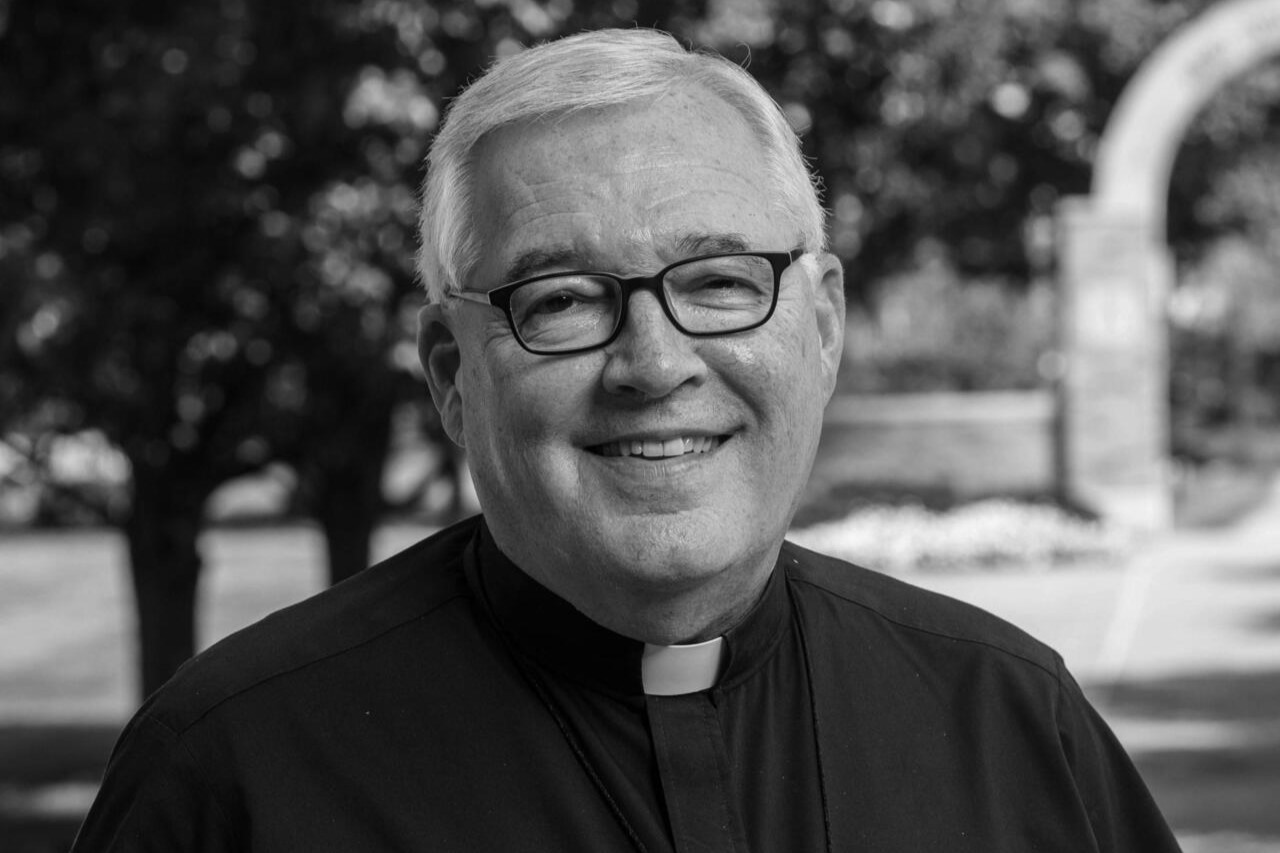
Almost half of Brother’s life as a religious has been devoted to the University of Portland. He arrived here in 1988 to teach history and political science, became dean of the College of Arts and Science in 1990, and was named Academic Vice President and Provost in 1996. His 16 years as Provost is the longest anyone has served as chief academic officer in the history of the University.
Brother has had an enormous impact on all of our lives and it is good to remember what has happened here during his tenure.
- Undergraduate enrollment has doubled;
- Retention of freshmen has gone from 83.1 % to 90.7%;
- The average high school GPA of our freshmen has risen from 3.57 to 3.68;
- The average freshman SAT score has risen 41 points;
- The four year graduation rate has gone from 83% to 93%;
- The number of full time faculty members has risen from 170 to 218.
And through each of his 24 years here Brother has continued to teach at least one class every semester and countless workshops and seminars for alumni and the public at large.
Brother will forever be recorded in our history as one of our legendary figures, an architect of the modern University, and a man who has embodied the spirit of Blessed Basil Moreau, the founder of the Congregation of Holy Cross, by being a man who brings hope to others. We will miss him deeply.
You will each have an opportunity to express your thanks to Brother at the reception that follows our gathering today, but I want to speak for all of us in expressing thanks to Brother for his faithful service, his wise stewardship, and his devoted friendship. We will miss you, Brother, and we wish you Godspeed as you assume your new responsibilities. We all pray that after you serve the Province in that important role you will rejoin us here on The Bluff.
Last Friday morning we showed a video to our new students and their parents when they were all gathered in the Chiles Center. Laurie Kelley and her staff in the marketing and communications department prepared the video and if you will turn your attention to the screen I would like to show it to you now so you can see one way we welcomed these new members of our community.
Thank you, Laurie, and thanks to all of you whose teaching and research and work with our students made possible all that we saw in that video.
These years during which I have served the University as its president have been remarkable ones. We have experienced some of the most wonderful and successful times in the University’s history. Yet at the same time, the downturn in the national economy and the rapidly changing higher education landscape have created an environment unlike any that we have seen in our lifetimes.
For us, these have been the best of times because of the evolution and maturation of the University and because of its growing strength and confidence.
A few years ago, you might recall, when I spoke to you at this annual convocation, I drew your attention to a number of things that were indicators that we had moved to a new era in our history.
In 2009 it was clear that, for the first time in our history, we had the luxury of planning our own future. No longer were we in survival mode, when each new year was fraught with anxiety about whether we would enroll enough students to meet our budget. We could now think seriously about what we wanted to be as a university and develop a plan to make that vision a reality.
The past three years have only underscored that sea change in our fortunes. We have moved from ‘survival mode’ to ‘flourish mode’ and the Strategic Plan we adopted a year ago is evidence of that.
In the last decade, for example, our applications for admission have more than quadrupled. A decade ago our freshman class had an average high school gpa of 3.57 and average SATs of 1169. This year it is 3.67 and about 1200.
Ten years ago we retained 85% of our freshmen; today we retain over 90%.
In 2002 we had 1 student Fulbright scholar throughout our entire history; today we have 40 student and 12 faculty Fulbright awards.
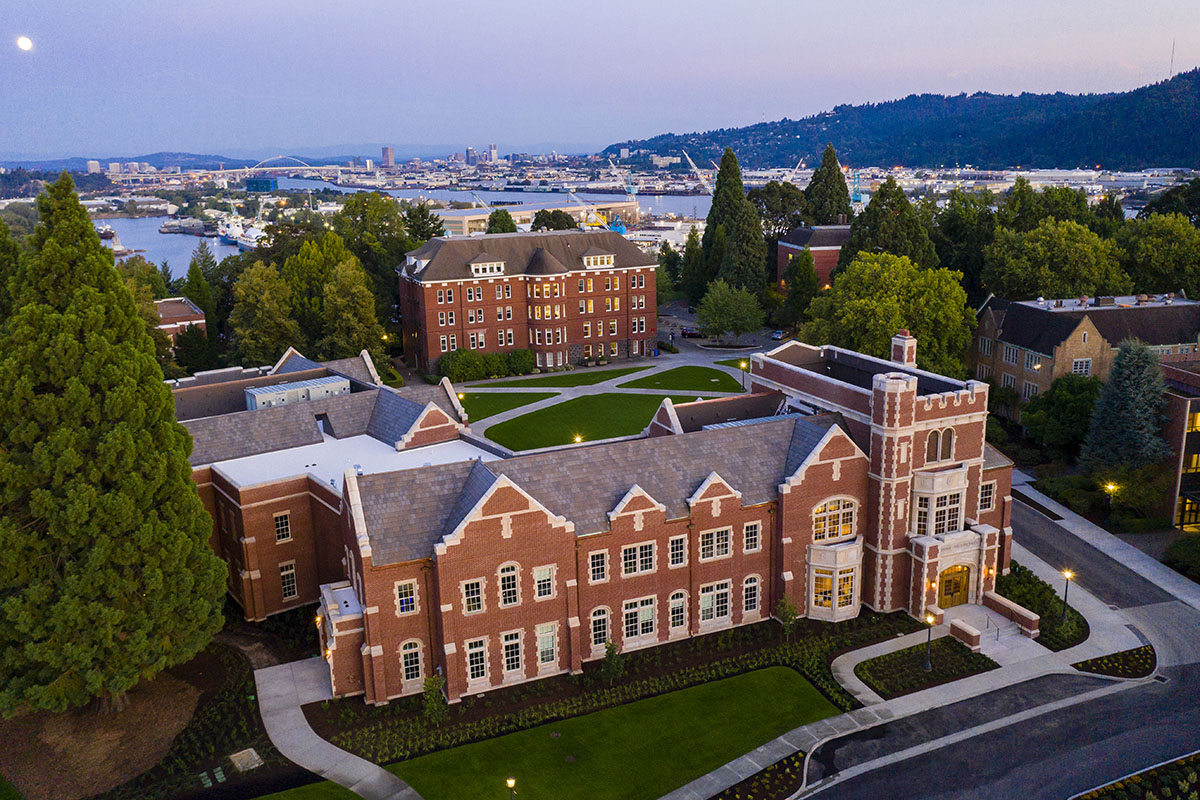
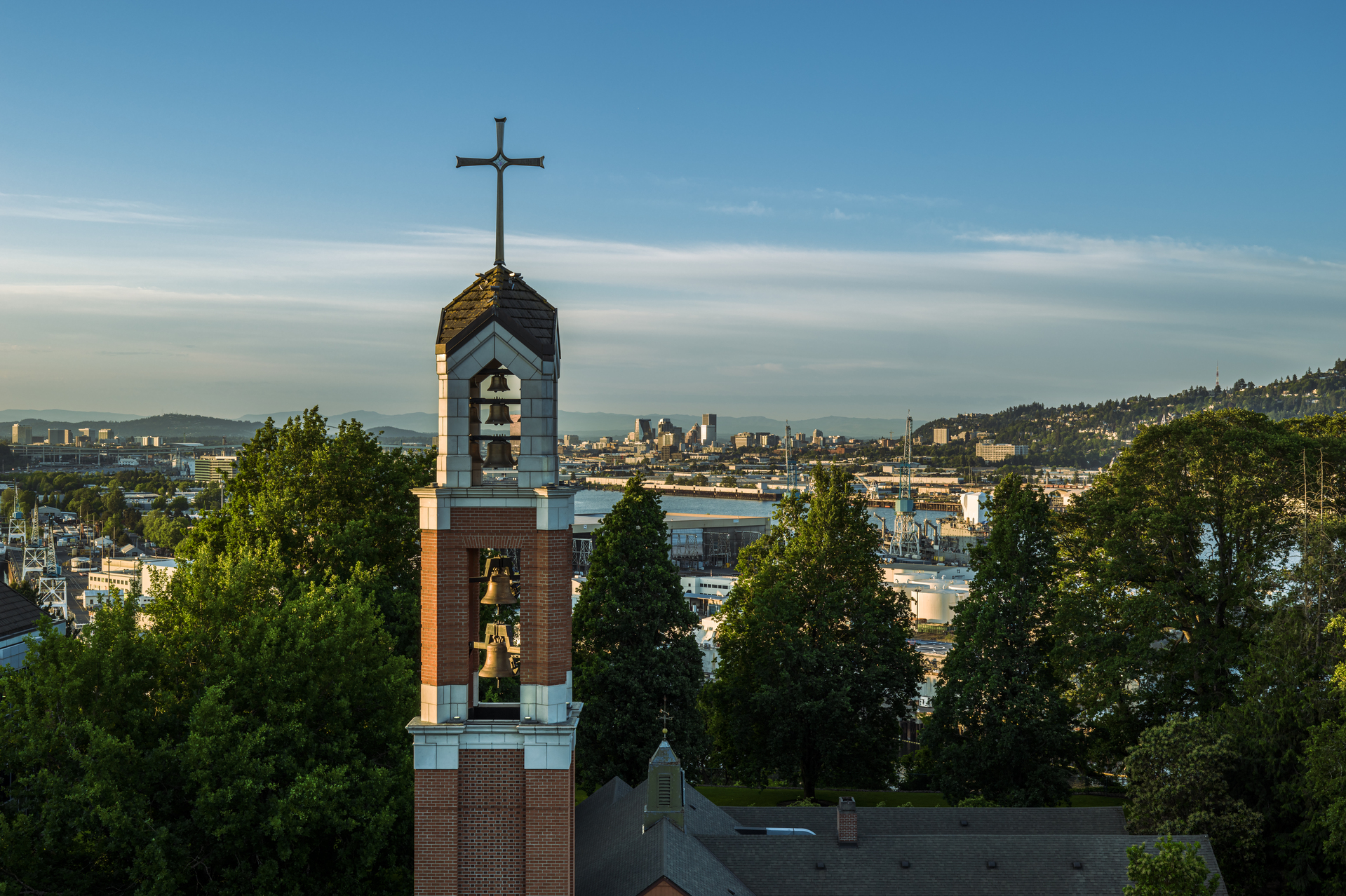
The past ten years also have seen a transformation of the campus: the expanded and reconstituted Shiley Hall, the enlarged Bauccio Commons, the renovated Romanaggi Hall, the addition of Schoenfeldt and Fields Halls, the expansion of the Chiles Center, the addition of the Bell Tower, renovations of Villa Maria, Shipstad and Kenna Halls, the addition of the 35 acre River Campus, and the complete remodeling of Clark Library.
Much of this comes as a result of our RISE campaign, which as of today has raised more than $135 million – that is correct: $135 million -- with two years remaining.
All of these things are visible signs of our success and strength. What you do not see on the news or when you walk around the campus are things like this:
- Although we had a wage and salary freeze for one year at the beginning of the recession, we have not had to let a single employee go as a result of the downturn in the economy;
- In 1989 60% of the nation’s faculty were tenured or on tenure track. At UP, 55% of our faculty was tenured or on a tenure track. Today the national average has dipped to 25%. At UP it remains at 55%.
- Our faculty and staff salaries are now at the mean of our peer institutions.
In so many ways these are indeed the best of times for the University of Portland. As I explained three years ago, however, the essential lesson we must learn from this is that the experience of establishing objectives crucial to our mission and securing funds with which to achieve those objectives is a new experience on this campus. We have realized a growing sense of financial empowerment at the same time we have achieved a growing mastery of our enrollment. This has resulted in an institutional self-confidence unlike any we have ever known and this gives us an exceptional opportunity to shape our future, rather than have it shaped for us. This is fairly rare among institutions of higher education, especially among our peers.
For much of the University’s history, the fundamental issue was whether or not it would survive. Now we are asking ourselves what kind of university we want to be. In that sense alone, these are truly remarkable times.
Yet you only have to read the news every morning to know that in the world around us these are also extremely difficult times for higher education and those who aspire to it.
We are in the fourth year of a recession that has shattered dreams and that is corroding hope. Families are reducing their spending. Household net worth is down and the number of college students who live at home is up 9% this year alone.
For-profit institutions are siphoning billions of educational dollars away from traditional schools like ours.
The technological revolution has caused many people to challenge traditional methods of teaching and learning and an aggressively pragmatic culture is abetting that challenge.
You may have read in recent weeks of the warnings about the continuing financial challenges that confront higher education. Moody’s said several external factors are making it difficult for colleges and universities to grow revenue. As a result, Moodys says, the focus must shift to governance, operating efficiencies, and revenue diversity. Standard and Poors added to this the fact that private colleges have increased spending on student aid to remain competitive.
Meanwhile, the cost of a college education has risen dramatically, driven in large part by skyrocketing health care costs, improved salaries, and what we might call “the facilities competition”, putting education out of reach of many worthy students. Here at UP, in the last 10 years, tuition has almost doubled to keep up with those costs. Around the country many students and families are taking on significant debt to attend college. Others are resisting the price increase and looking for other options. Some schools are even responding by taking the very risky step of freezing or even reducing tuition.
The recession has shrunk every school’s financial resources, most significantly by eroding their endowments. In the last decade, the Higher Education Price Index for private Masters degree granting institutions like ours has gone up an average of 3.6 % a year compared to the increase in the Consumer Price Index average of 2.7% and the growth of the median family income average of just 1.8%
So dramatic and newsworthy has all of this been that now the federal government is starting to get involved and Congressional committee hearings into student debt and tuition increases are in the offing.
There are few people who are closely familiar with the situation who would disagree that these are the worst – or at least among the worst – of times for higher education.
And so we find the University of Portland enjoying its remarkable success while higher education in the U.S. is in great distress. And it is our response to that irony about which I wish to speak today.
We find ourselves at this moment of our history in a position of great strength. Yet in spite of our strengths, we are vulnerable. There are forces far beyond our control to which we must be ever alert. Ten years from now we must not find that we have moved from strategic planning to emergency planning.
We don’t have the luxury of a large endowment or deep reserve funds to provide a measure of protection. Consequently, we must plan carefully and thoroughly and act wisely to responsibly steward our resources and blessings.
In all the work that we have done in recent years and behind all of our many successes has been a steadfast focus on our mission and a careful adherence to the charge given to us more than 175 years ago by Blessed Basil Moreau, the founder of the Congregation of Holy Cross. For Moreau, true education required a balance of mind and heart -- the balance between knowledge and skill, inspiration and discipline, information and insight, learning for its own sake and learning for the sake of utility. It is not always an easy balance to find.
Yet through a century of enormous change in higher education, through the 1960s and 70s, in the midst of the clamoring voices of the technological revolution, we have continued to offer courses that provide a vocabulary for discussing ultimate questions that are of special importance to young people. True to Basil Moreau’s charge, we have steadfastly helped students to develop their character, we have helped them learn how best to live, just as we have helped them learn how best to make a living.
This is a significant contribution to the landscape of higher education and we should all feel justly proud of our unwavering commitment to our mission and to our students.
All of this we have always done as a community of scholars and learners.
Last January, Michael Andrews, the McNerny-Hansen chair in ethics and our interim dean in the College of Arts and Sciences, spoke at his installation about what we seek here and how we seek it. Dean Andrews stressed that we humans are “innately social beings, that we do not exist in isolation, and that “to be human means always and everywhere to exist in community.”
Through our community, Dean Andrews reminded us, we seek to develop what Pope Paul VI called “a new humanism…which will enable human beings to find themselves again, to be sensitive to human pain and social injustice.”
We do that year after year because of you and because of the good will and care you bring to our community. Throughout all of his writings Moreau gave highest priority to the quality of the people teaching in his schools. Those personal qualities of teachers at a Holy Cross school – YOUR personal qualities – are what makes Fr. Moreau’s vision of education work.
The philosopher Alasdair MacIntyre once described the ideal university as “a community of inquiry made up of faculty with diverse interests but whose members agree on ultimate values.” This is one of the characteristics that distinguishes UP from most other schools in the country: all of us here agree on our ultimate values – teaching and learning, faith and formation, service and learning.
A university is only as good as its faculty and staff, and your devotion to our mission, your appreciation of the unique values of Holy Cross, and the teaching talent, the knowledge and the skills that you bring to the University have made possible all the fruits that we celebrate and enjoy.
For us to continue our momentum at a time when economic forces are bearing down heavily on higher education will require attention from all of us to the ways in which we manage our resources.
The issues of funding, revenue, and reallocation are mundane, certainly, but they are crucial to our daily lives and work. We cannot achieve all we hope to achieve without the funds to support our work.
Traditionally, we think of our major sources of revenue as tuition, endowment earnings, and benefactions. Each of these revenue streams has come under pressure in recent years. But there is another revenue stream that I would call “resource management” – the use of energy saving devices such as the new, energy efficient windows that were installed in Kenna Hall this summer, or the reallocation of existing resources to new or different initiatives, or the savings that are generated by new and efficient ways of delivering services and performing our daily tasks. I am especially grateful to our Information Services staff for their constant effort to introduce ever more efficient technologies to our work places.
The resources we have – our buildings and grounds, our classrooms and labs, tuition and fees and endowments and benefactions – impose on each of us a responsibility to use them well in service of our mission. We have a responsibility to make the most of all the blessings that we have received.
Make no mistake about it: the University of Portland is an expensive enterprise. Our current budget runs more than $1xx million. If we are to continue our momentum, if we are to continue to provide a rich learning experience for our students, we must continue to practice effective resource management, the sort of management that requires careful evaluation of areas of opportunity and tough fiscal discipline to make it successful.
We are a Catholic university and we do not shrink from our religious obligations. And we are an increasingly excellent academic institution and we will not hesitate for a moment in our pursuit of excellence. But neither our religious commitments nor our academic achievements will be of much use to the University if we are not mindful of our financial circumstances and rigorously attentive to them.
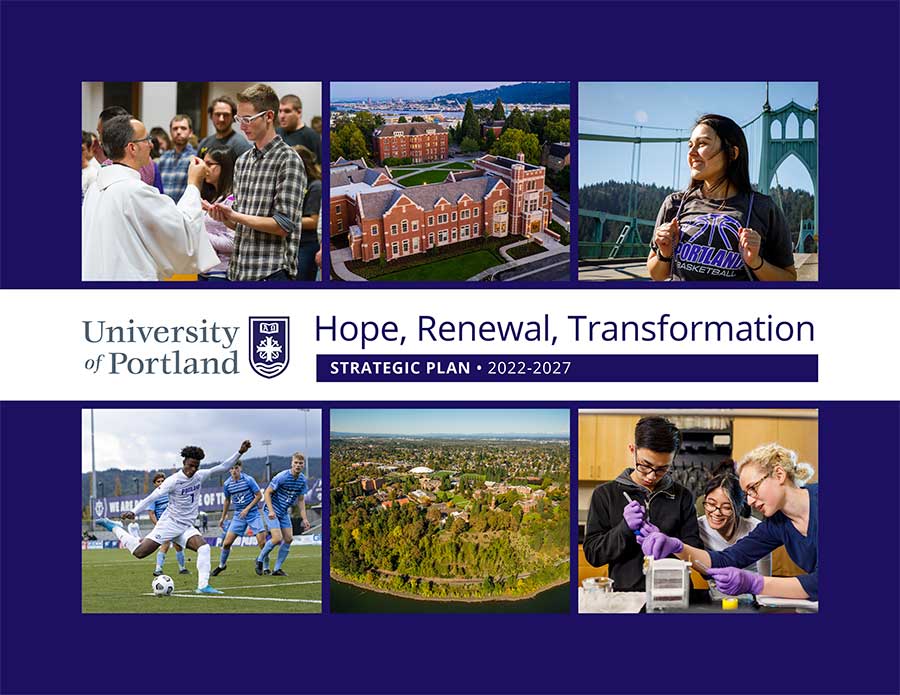
The Strategic Plan which we completed last year and that was approved by our Board a year ago is a tool that is helping us to navigate our way through the challenges we face. Our Plan was undertaken to increase our effectiveness as educators and to increase the impact we have on the lives of the students entrusted to us.
The Plan will be effective because it recognizes our limits and identifies and targets priorities rather than address all of our wants and needs. While the Plan does not and cannot articulate all the important work we do and need to continue doing, meeting the priorities it sets forth is crucial to our success. After years of struggling to survive, the University of Portland now can do anything it chooses to do. It just cannot do everything.
As you will recall, we began our planning with several guiding principles. Among them are that:
- We are a community, not a loose confederation of academic disciplines;
- We are a residential community and are committed to the residential experience as a primary way to educate the minds and hearts of our students;
- We believe that it is through personal relationships that knowledge and values are exchanged.
These are the touchstones of our community.
William Butler Yeats wrote that “In dreams begin responsibility.” And so it is for all of us. In the dreams we articulated in our mission and vision lay the seeds of our responsibility to realize that vision and fulfill our mission. Our Plan is helping us to meet our responsibility.
One of the significant charges laid out in our Plan was to create the University’s first enrollment management plan.
The dream of creating an enrollment management plan has been around the University for years, if not decades. But it is only during the last decade that we have finally been in a position of sufficient mastery to create one.
And the dire state of the economy has not diminished our enthusiasm for this task. In fact, it has increased it.
To get a better idea of why enrollment management has become so absolutely essential to the University consider these facts:
- Over the past 10 years the University budget has increased by an average of 7% per year;
- During that same 10 years, our tuition has increased by an average of 5.7% per year;
- 83% of our operating budget comes from tuition, room, and board;
- We have a deferred maintenance requirement over the next four years of $17.25 million.
You are probably asking yourself what this data has to do with enrollment management, and the simple answer is this: Everything. Because we are so heavily dependent on tuition, how we manage our enrollment influences everything we do. Enrollment affects salaries and benefits, it affects numbers of faculty and staff, size of classes and size of classrooms, and it affects our aspirations, our vision, and our mission.
It does not require the keen minds of our math faculty or the staff in our finance division to show us that our expenses are increasing faster than we can raise tuition, and have been for decades, and that such a method of operation is not sustainable. Our enrollment is two times what it was a dozen years ago yet on the whole, our financial situation is about the same.
The good news is that we are not faced with a crisis, as are many schools around the country today. Because of prudent management in the past, and because the University is increasingly attractive to high school students, we are in a good financial position. But as I said earlier, we are vulnerable to unforeseen economic factors far beyond our control.
It is for this reason that the enrollment management plan that we have all desired for so long is of such importance right now. By planning prudently and responsibly we can ensure that the years ahead will be even more stable and secure for the University, for our students, and for each of us than they have been in the past. We work and learn as a community and we will become stronger as we manage our resources as a community.
Last fall I appointed our Executive Vice President, Fr. Mark Poorman, and our Interim Provost, Tom Greene, as co-chairs of a committee to create the Enrollment Management Plan called for in our Strategic Plan. During the last academic year, 37 of you worked with Fr. Mark and Tom to study the issue, to frame our discussion, and to identify options and opportunities that will allow us to continue to improve the learning experience we offer and that will help us sustain those things that define us as a Catholic, Holy Cross university:
- academic programs that develop high achieving students;
- residential life and student programming that develop strong character;
- and real world experience that develops leadership and an ethic of service.
That committee has produced a 28-page report of their findings and more than 50 pages of supporting material.
And now, during the next four months, Fr. Mark and Tom and members of their committee will meet with you to discuss those opportunities and to solicit your insights and recommendations. We need your thinking on this vital project. This Enrollment Management Plan will describe the future of the University and identify how we might achieve our aspirations.
I have asked that a final report with recommendations be submitted to me in December so that I might present it to our Regents during their meeting in January.
I know that you will bring to these discussions the same energy and enthusiasm that you bring to your students, and I know that you will help ensure a stable and prosperous future for this University that has laid its claim on all of us.
This past weekend the campus was filled with parents and families and friends who were entrusting us with their sons and daughters. They believed in us enough to allow us to educate their children and to continue the work they have begun in forming the character of those young men and women. Our challenge – our responsibility – is to live up to that trust every day. That is what has been done so well here at the University for 111 years and it is what we will do so well in the year that lies before us now. And I am grateful for the enthusiasm and collaboration that each of your brings to this sacred calling.
As we all leave here today and renew ourselves as a learning community, I am reminded of the words of Blessed Basil Moreau and I invite you to remember them:
“An education that is complete is one in which the hands and the heart are engaged as much as the mind. We want to let our students try their learning in the world and so make prayers of their education.”
And so make prayers of their education.
Let those words be the inspiration for all of us gathered here – to make a prayer of this education that we begin today.
Thank you, and God bless you all.
-
- webmaster@up.edu
- 503-943-7101
- Directions & Maps
- 5000 N. Willamette Blvd., Portland, OR 97203-5798
- © 2013 University of Portland, All Rights Reserved