December 2025
We Are All Connected
A career in the US Air Force brought her back to her family roots in the Philippines.
- Story by Eileen Bjorkman
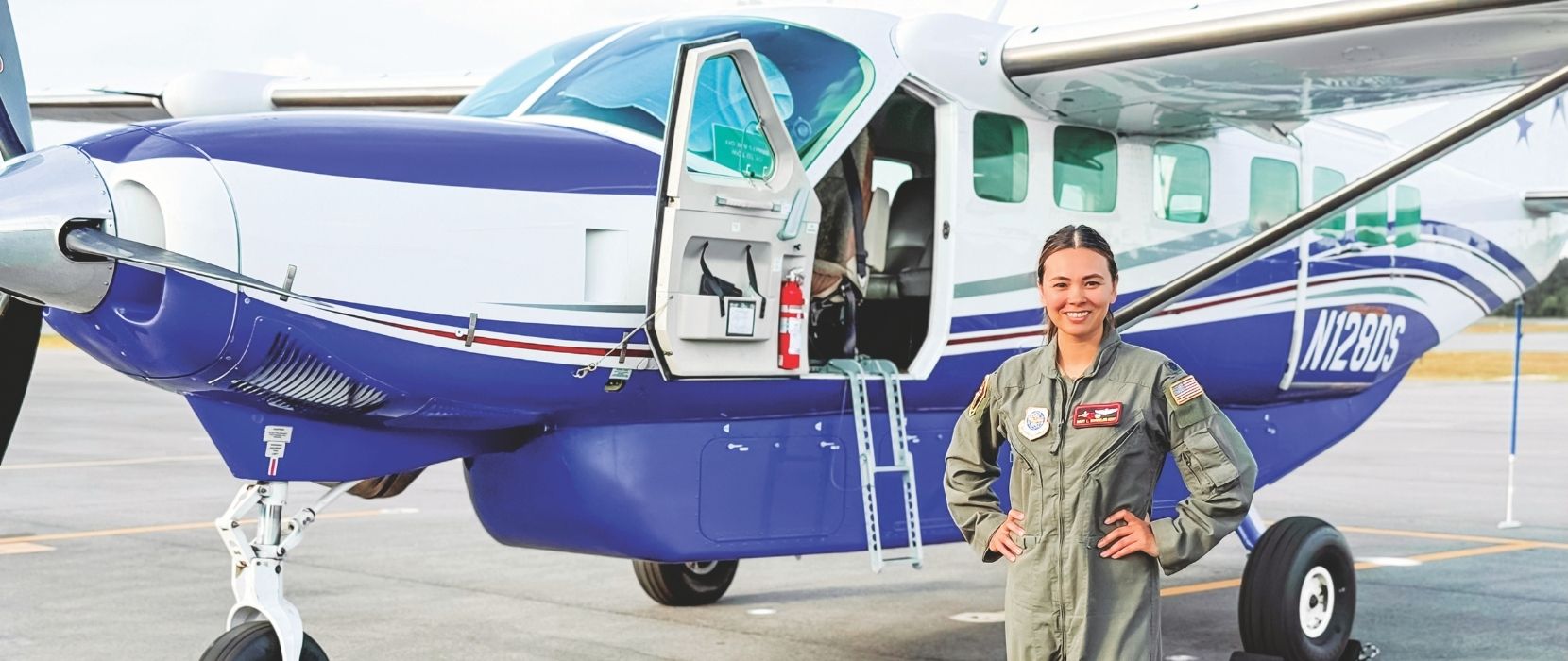
US Air Force Lt. Col. Mary Lea Bordelon, Commander of the 571st Mobility Support Advisory Squadron, Travis Air Force Base California
FOR US AIR FORCE Lieutenant Colonel Mary Lea (Miller) Bordelon ’09, mentorship is one part of her job. But it’s also part of her life. She tells people, “As you’re rising through life, look around and grab someone else by the hand.”
Bordelon’s own life was changed by people who grabbed her by the hand. She was born into a working-class family in Portland, the second daughter of an American father and a Filipina mother. Her parents had met as pen pals, and her father eventually proposed via phone call saying, “I am coming to get you.” The two later married in a civil ceremony.
As a child, Bordelon made regular treks across the Pacific with her family to visit relatives who lived on Cebu Island in the Philippines, about 350 miles southeast of Manila. During her first trip in 1992, when she was five years old, she recalls being handed over a fence at the Mactan-Cebu International Airport “into the arms of loving strangers … I mean family.”
The world Bordelon’s mother left behind was very different from the family’s world in Portland. Bordelon’s Lola—the Filipino word for grandmother—lived in a nipa hut, a stilt house constructed from bamboo and wood. The hut had no running water. But Bordelon says her relatives were happy, and she recalls her visits with fondness, visits filled with family activities that included braiding hair with her cousins and taking public transportation in jeepneys—jeeps stretched like a limousine. During that first trip, her parents purchased some land and began building a concrete house for her Lola. On subsequent visits, up to 20 people slept on the floor of the house, which decades later now has cold running water. Bordelon’s Lola eked out an existence through ventures such as raising chickens, which she sold for less than $3.00 each.
For as long as she can remember, Bordelon has always had to navigate two worlds. She reflected on this as part of a collection of stories by US Air Force Asian Americans and Pacific Islanders. “The thought of Lola, my aunts, and uncles, and my first cousins and their children, living a life completely different from mine has always been difficult for me to grasp,” she wrote. “Handwashing every piece of clothing seems like a full-time job. A refrigerator is a luxury, not a necessity.” She wrote that she grew up in America with feelings of both guilt and luck.
Bordelon was raised in the St. Johns neighborhood of Portland, near University of Portland. She and her sister attended Mass every weekend at nearby Queen of Peace Catholic Church with their mother, a devout Catholic. The sisters attended public schools, and in 2001, her last year of middle school, Bordelon looked forward to attending Roosevelt High School and joining her sister on the school’s cheerleading team. The sisters already had many friends in common. Then one day at a parent-teacher conference, Bordelon’s teacher asked, “Have you considered any private schools? Because I want you to be challenged.”
The teacher wanted Bordelon to go to college, even if higher education just wasn’t part of her neighborhood’s culture.
In a twist of fate, Bordelon knew about a private school opening in the vacant parochial school at Queen of Peace. She asked her mother if she minded if she looked into the school, named De La Salle North Catholic. Her mother told her she would support whatever she decided.
Bordelon met with UP alum Matt Powell ’84, also De La Salle’s founding president, to get information. She learned that in the first year the school would consist of only a freshman class. A new class would come in behind them each fall for the next three years to make a full student body during the first class’s senior year.
Bordelon’s family wouldn’t have considered cross-town, full cost private schools, but De La Salle is part of the Cristo Rey Network of schools, which focuses on providing a college preparatory curriculum to underserved communities. The first Cristo Rey school was founded in Chicago in the mid-1990s; De La Salle is the second school. All Cristo Rey students take part in a Corporate Work Study program that requires them to attend classes four days each week and work on the other day. Their earnings defray a significant portion of the school’s tuition. The jobs aren’t typical teenager jobs in fast food restaurants; they are administrative jobs in local businesses so that when students graduate, they already have full resumes.
As Bordelon considered her choices, she thought of the life her cousins lived in the Philippines and the opportunities her mother had after coming to the United States. Now Bordelon was being given an opportunity. The idea of going to a school that didn’t even exist yet and not knowing any of her classmates was scary, but she realized the school could set her on a different path. She applied and was accepted.
She began classes in September 2001. She says the school was quite different from Roosevelt: “There was a dress code, and it was business professional, so I had to buy high heels and skirts and things like that.” With only one class of freshmen consisting of a few dozen students, there were no established sports teams.
One week into the school year, the students, all still strangers to each other, held each other in the school hallway and prayed on the day of the catastrophic events of September 11. Although the terrorist attacks brought the students closer together, Bordelon says, “September 11th was like the shadow of our whole high school career.”
For the next four years, the students tried to tie all their actions, thoughts, and how they spent their time into De La Salle’s three tenets: faith, service, and community. Bordelon says her time there changed her life by opening her eyes to what she could do. Mentors at work encouraged her further, and one even offered to pay for her books in college if she kept her grades up. The experience at De La Salle was so pivotal for her she is now on the Cristo Rey Network National Board of Directors and recently gave the commencement speech for the Class of 2025.
In 2005, Bordelon graduated as one of the 55 members of De La Salle’s inaugural class. The class had a 95 percent college acceptance rate, and she was one of the college bound. She had originally hoped to go to a school away from Portland but instead followed her boyfriend to the University of Portland. The boyfriend didn’t last very long, she says.
What did last was yet another opportunity, a chance for a career in the military. Bordelon had always been interested in joining the military, but peer pressure had kept her from researching her options. Then in class one day, a friend of hers in UP’s ROTC program gave a presentation on the Twilight Brigade, a volunteer organization that provides end-of-life care to veterans, especially those without family. Bordelon, who missed the community she had built in high school and had yet to find in college, says, “When I heard that presentation, it just reminded me of the community of the military, and I [remember on] September 11th feeling grateful for people’s service before me, and even my mom’s family in the Philippines taking opportunities when they had them because … they don’t have a lot of opportunity. [In the US] it’s harder for some than for others, but there are opportunities, and I thought, ‘Why am I leaving this on the table?’”

1st Lieutenant Miller (Bordelon) during open ocean drop-and-drag exercise at Parachute Water Survival Training, Pensacola Bay, Florida, 2011.
Her next stop was the Air Force ROTC office, located in the basement of her dormitory. She entered the program her sophomore year and struggled to catch up with those who had joined as freshman. The late start also prevented her from earning a scholarship, even after she received a superior performer award at summer boot camp. The lack of a scholarship once again made her a part of two worlds. The scholarship cadets had all their tuition, room and board paid for, and they all lived together in the same dormitory. Bordelon lived separately and worked a part-time job to help her parents pay for school. The cadets mostly hung out with each other, but Bordelon also had many friends outside of ROTC. She participated in official ROTC events but often missed out on social activities because she lived separately.
Even without a scholarship, Bordelon was eligible for all other cadet opportunities, so although she knew nothing about flying, she applied for pilot training. She was accepted and in 2009, after receiving a bachelor’s degree in sociology from UP and graduating from the ROTC program as a distinguished graduate, she headed to pilot training at Vance Air Force Base in Oklahoma.
Pilot training proved challenging. At one point, she had failed too many flights and was eliminated from the program. Washing out of pilot training also put her Air Force career in jeopardy. After a decade of growth following the terrorist attacks, the Air Force was downsizing, and instead of sending those eliminated from pilot training to non-flying positions, many were being discharged. She had one more chance though: a reinstatement board that could give her another shot at being a pilot.
When Bordelon met the board, they asked why she wasn’t keeping up with her peers in training. She didn’t have a good reason. She knew they wanted to hear something like her mother was sick or she had a stressful home situation. Instead, she told them, “I think my head was not in it. I didn’t believe in myself, and I’m requesting a second chance.”
Apparently impressed with her honesty and drive, the board reinstated her, and she rejoined pilot training in a different class. She was determined not to fail again. It was the first time she had ever failed at anything, and she recalled it as the “scariest professional moment of my life.” But the failure also “lit a fire…and I worked harder than I ever had in all my life to pass all my flights.” Awarded her pilot wings in the summer of 2011, she went on to fly the C-130, a four-engine turboprop aircraft the Air Force uses for a wide variety of missions, including delivering cargo to airports with dirt runways, dropping Army paratroopers, and evacuating patients from remote locations.
Bordelon spent the next seven years flying C-130s first from Dyess Air Force Base in Texas and then from Ramstein Air Base in Germany. During this time, she married her husband, who works in federal law enforcement.
In 2012, not long after she began flying C-130s, Bordelon made her first deployment to Afghanistan. In bed the first night, she heard bombs exploding and guns firing. She remembers thinking that she was in a war zone and just about anything could happen to her. Despite being with her squadron and having a roommate, she suddenly felt very alone. But lying in the dark, she prayed and realized she wasn’t alone. Being in a combat zone also made her reflect more on her faith. She says, “Inevitably there are some significant emotional events where … I [think] I am about to die or someone else is about to die … so that’s really more in your face about mortality.” That close-up view of mortality had a clarifying effect for her. She started to ask: “How am I living my life?”
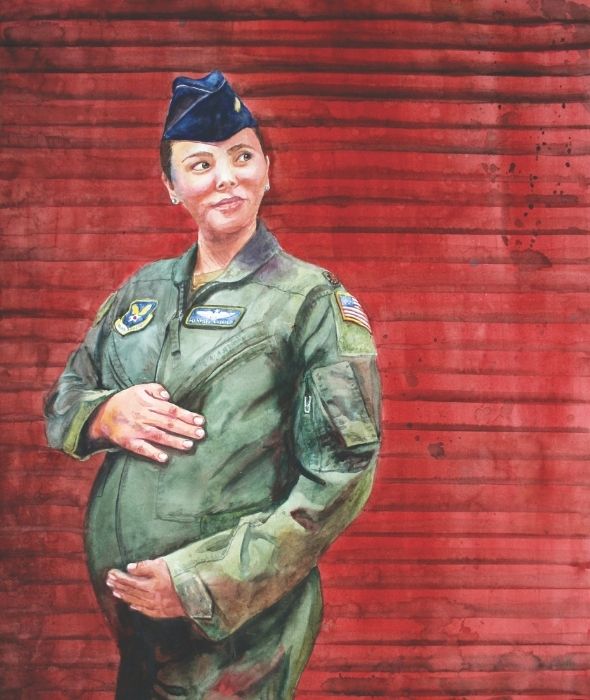
While at Ramstein, Bordelon had her first child. At the time, the Air Force’s policy was to ground pilots for the duration of their pregnancy. After her son was born, she resumed flying. When she became pregnant with her second son, the policy had changed to allow women to fly from week 12 through week 32 of their pregnancy. By then she held a non-flying desk job in the Pentagon, but she helped other pregnant aviators by testing a maternity flight suit.
She laughed as she recalled, “They took my measurements… and put an extra panel on the sides. They were trying to see how long this would last a pregnant woman to wear. And I have big babies; they were almost ten pounds each. [For me] you’re going to need multiple iterations to last one pregnancy.”
During the test program, artist Cary Smith, the wife of one of Bordelon’s former commanders, was painting a watercolor series of Air Force women. Bordelon was one of her subjects. The watercolor of her wearing the test maternity flight suit received more attention than any other in the series, and the Air Force later accepted it into the Air Force Art Collection. The maternity flight suit made its official debut in 2022.
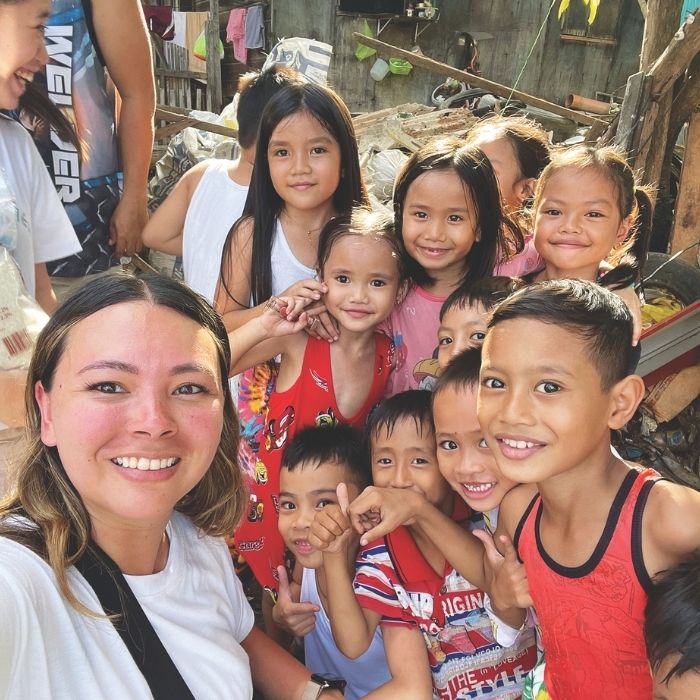
Bordelon and barangay (neighborhood) children during one of many giveaways throughout Cebu, Philippines.
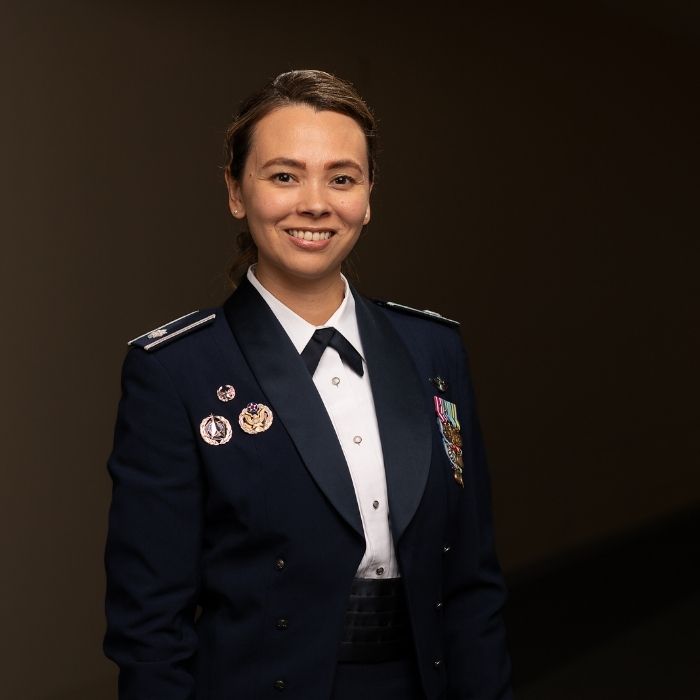
Lt. Col. Mary Lea Bordelon at UP's 2025 military ball; photo by Bob Kerns.
During her Pentagon tour, Bordelon also made an official visit to the Philippines that brought back youthful memories. Years earlier, she had landed an Air Force C-130 in the Philippines during a fuel stop as she returned from a deployment, but the later visit was more special. Surrounded by C-130s as she stood on the Philippine Air Force’s ramp at the Mactan-Cebu International Airport—a ramp she didn’t know existed until the visit—her view was drawn to the civilian side of the airport. In a full circle moment, she spotted the terminal building and remembered being passed over the fence 30 years earlier as a little girl. She would soon have other official opportunities to visit her mother’s homeland.
After serving at the Pentagon for four years and receiving a master’s degree in international relations and conflict resolution, Bordelon was selected to be a squadron commander, one of the most coveted jobs in the Air Force. Equivalent to a middle management position in the private sector, only a small percentage of officers are selected to command squadrons.
The Air Force assigned Bordelon to lead a squadron she didn’t know existed. In June 2024, she took command of the 571st Mobility Support Advisory Squadron (MSAS) at Travis Air Force Base in California. Her squadron of 80 people in the Air Force is one of two active-duty squadrons fully dedicated to training, advising, and assisting the air forces of partner nations. The 571st MSAS provides air advisers who speak Spanish, Tagalog, and Japanese to countries around the world, including the Philippines. Bordelon was a perfect fit.
In her role as commander, Bordelon also now flies a much smaller aircraft than the C-130: a single engine Cessna C-208 that many of the partner nations operate. The US Air Force doesn’t own one, so she and the other handful of Air Force C-208 pilots occasionally travel to a contractor facility in Florida for refresher flight training.
In July 2025, Bordelon and members of her squadron made an official trip to the Philippines to meet their counterparts in the Philippine Air Force in Cebu. On the next to last day of the trip, she invited the partners to a “giveaway” in the area where her mother’s family lived. The giveaway was a tradition Bordelon had started when she was 14, using her own money to give something back to her mother’s community each time she visited. This year, she and her team focused on about 30 families whose homes had been destroyed in a catastrophic fire. The team bought wash basins, bags of rice, and about five hundred toys. The gifts might not sound like much, but wash basins are fundamental in the Philippines for bathing, washing dishes and clothes, and transporting water, among other things. Each bag of rice feeds a family for five days.
The team first distributed the wash basins to the fire victims and then gathered the rest of the families to distribute the rice and toys. The rice delivery was running behind schedule, and Bordelon says: “The kids were already sitting down, staring at the toys and when the rice rolled in they all just erupted in cheers and clapping. For rice. I’m trying not to cry. It’s a struggle that is hard for the majority of people [in the US] to understand, a child cheering for rice.”
After the rice was distributed, the kids lined up for their toys. Bordelon noted there were toys left over: the kids didn’t try to get back in line to take more than their fair share. The members of the Philippine Air Force who accompanied them were astounded by the giveaway, and one officer told her team he was so grateful that she had invited them along so they could see what they were all doing together. This response prompted an insight after a lifetime of navigating two worlds. “Even though we live in different countries and different circumstances,” Bordelon says, “we’re all connected.”
EILEEN BJORKMAN is the author of Fly Girls Revolt: The Story of the Women Who Kicked Open the Door to Fly in Combat.
More Stories
Muscle Memory
A priest takes the Camino de Santiago pilgrimage with his siblings. At a certain point in northwest Portugal—one week in, another week to go—he starts to wonder what he’s gotten himself into.
- Story by Fr. Patrick Hannon, CSC