What He’s Made Of
The largely untold origin story of Erik Spoelstra’s NBA coaching career and how his off-court passion for the special needs community has firm ties to his Portland Pilot roots
- Story by Joe Freeman
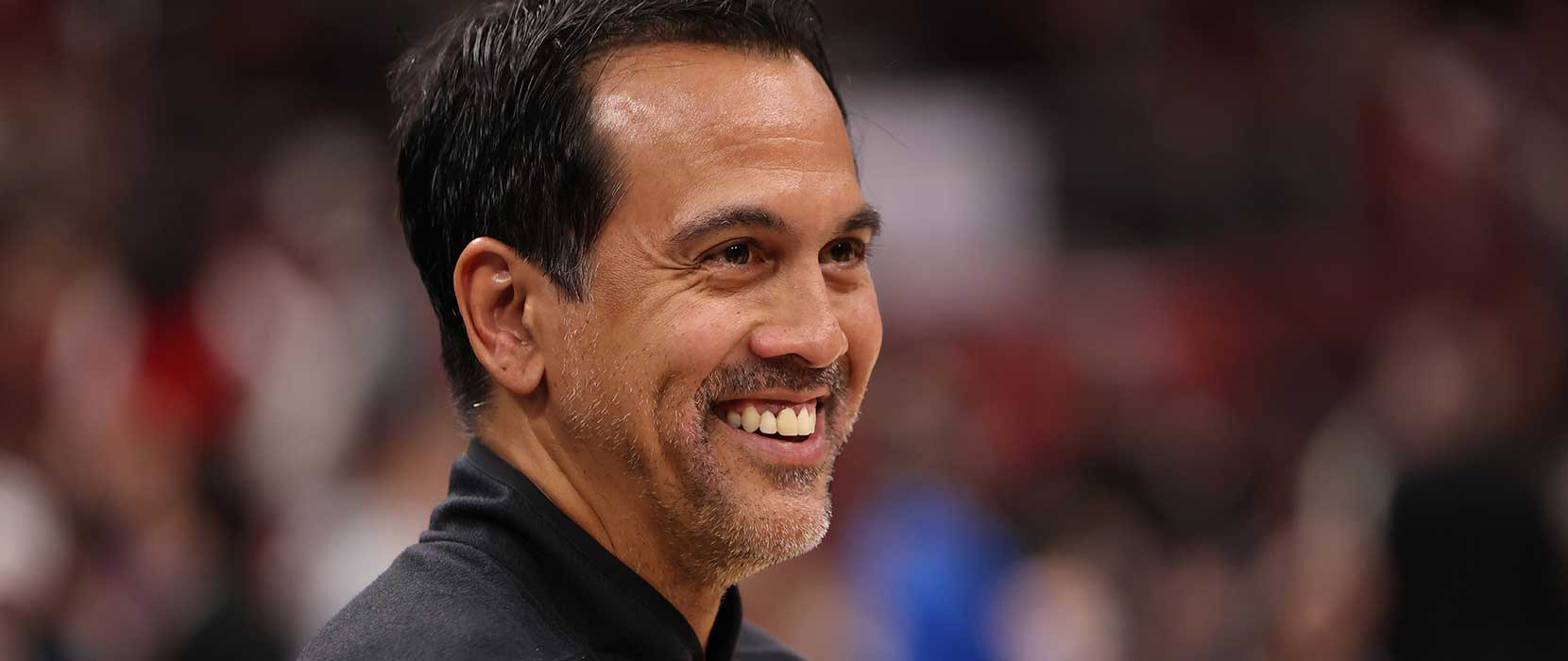
Photo by Geoff Stellfox/Getty Images
ERIK SPOELSTRA ’92 sauntered through a dimly lit tunnel and stepped onto the basketball court at Kaseya Center, though on this afternoon he wasn’t there to coach the Miami Heat. He gazed left, he gazed right, and a smile stretched across his face.
One hundred and sixty-five special needs athletes were scattered around eight different hoops, working on a variety of basketball activities. The athletes ranged in age, from eight to 80. The sounds of dribbling basketballs and squeaky high tops echoed amidst a stream of music from a disc jockey, who was mixing beats at a booth on the sideline. Burnie, a goofy 7-foot-6 “fireball” mascot with orange fur and flame-colored hair feathers, was bounding about, mingling with athletes at the third annual Heat Basketball Clinic.
Even though a sea of chaos was unfolding before his eyes, you could almost feel the stress of the relentless NBA season and the Miami Heat’s chase for a playoff spot wash away as if he had stepped into a spring shower on the quad outside Franz Hall. Spoelstra had arrived at his happy place.
He soaked in the scene, then dove into the pandemonium, strolling from court to court, exchanging hellos and high fives with campers and friends and instructors. Eventually, he grabbed a microphone and the arena hushed to a quiet.
“Are you ready to have some fun?” Spoelstra shouted. The athletes erupted in cheers.
“All right,” Spoelstra said. “Let’s get to work.”
Coming from him, these words were not a surprise. In NBA circles, Spoelstra’s work ethic is legendary. Since graduating from University of Portland in 1992, Spoelstra has evolved into one of the most respected basketball coaches in the world and one of the most prominent figures in professional sports. In 18 seasons as the Heat’s head coach, he has won two NBA championships, steered teams to four NBA Finals, coached in two NBA All-Star games and soared to No. 16 on the NBA’s list of all-time winningest coaches. In 2024, Spoelstra was named one of the 15 greatest coaches in NBA history by the league, joining legendary leaders like Red Auerbach, Phil Jackson, Gregg Popovich, Jack Ramsay, and Pat Riley. Last year, Spoelstra was selected to lead the USA Men’s Basketball National Team, meaning he will coach in the 2028 Los Angeles Olympics, and earlier this year, he became the longest-tenured coach in major North American sports.
But on this day, Spoelstra took a break from his high-profile career to coach and nurture one of his biggest off-the-court passions: The special needs community. He has become a champion for this community in Miami over the last decade, using his notoriety to bring awareness, financial support—and fun—to a group largely overlooked and underserved. The Heat Basketball Clinic has blossomed into a signature event for Spoelstra to highlight the community, providing a memorable opportunity for local special needs athletes and their families to take over the venerable NBA arena perched along the waterfront of Biscayne Bay near the postcard-worthy sandy beaches in Miami.
He strolled over to one court, where three campers made three consecutive jump shots, and beamed: “We’ve got some shooters at this basket!” Later, Spoelstra watched campers navigate tiny orange cones during a dribbling drill and jumped into the fray, demonstrating the proper technique. His two young sons were at his heels for much of the action, bouncing basketballs and hopping into drills alongside their father. The trio approached a cluster of campers in wheelchairs and started whipping passes back and forth.
As Spoelstra navigated the eight different baskets, he offered words of encouragement and chatted with everyone who approached, always with a smile. And the biggest smile of the day was saved for Court No. 2, where a special camper from his hometown was hoisting shots with a group of fellow teenagers. Her name is Sophie Flicker, and in that moment, she patiently waded through the line of shooters until it was her turn, sized up the rim, and launched a midrange jumper, which splashed through the net.
“Sophie!” Spoelstra shouted, before darting her way and wrapping her in a big hug.
Spoelstra’s passion for this community took root roughly a decade ago, when he attended a fundraiser at a special needs school in Miami. But he has a personal connection through Sophie, the teenaged daughter of Kasey Flicker ’97, Spoelstra’s friend and fellow Pilot.
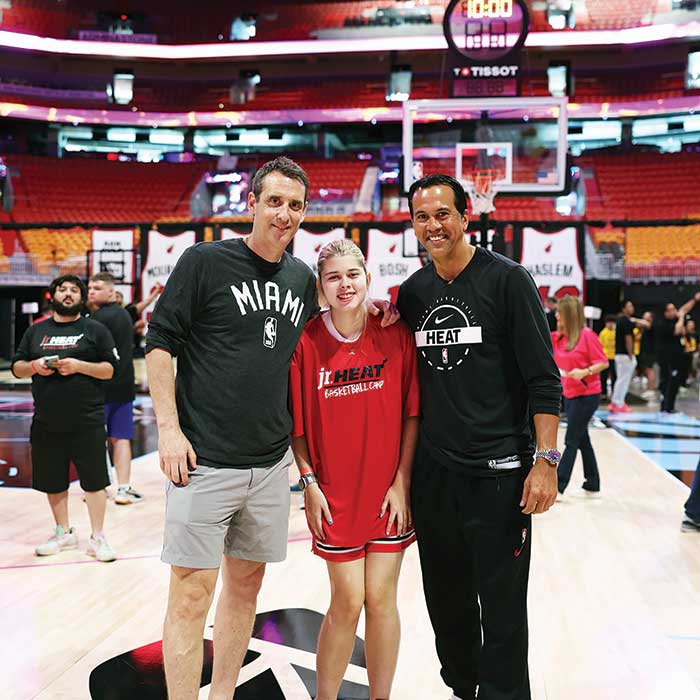
Left to right: Kasey Flicker, Sophie Flicker, and Erik Spoelstra on the court at the Heat Basketball Clinic (Heat Fan Photos)
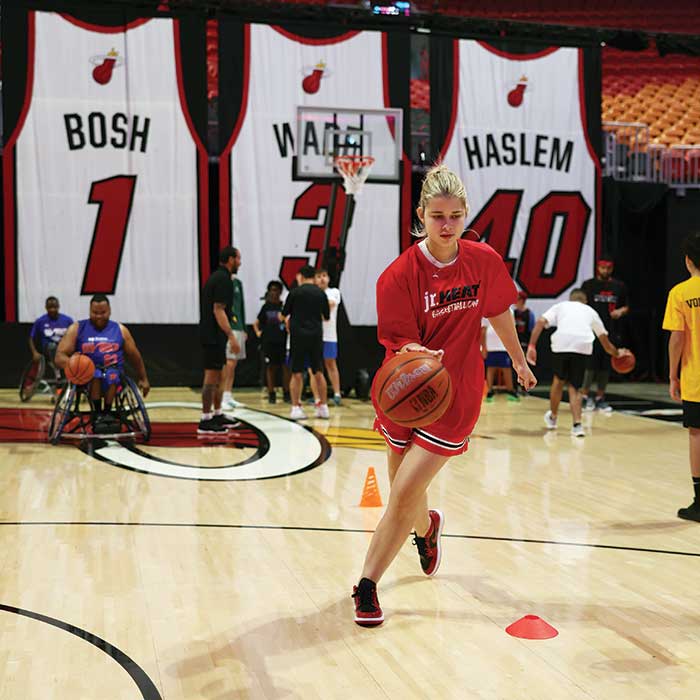
Sophie Flicker dribbles downcourt at the Kaseya Center (Heat Fan Photos)
Early Lessons from the “B” Team
IT’S BEEN MORE than four decades since Jon Spoelstra coached his son Erik’s middle school basketball team, but he recounts the good ol’ days as if he just strolled out of a practice at Whitford Middle School wearing a whistle around his neck.
The way the story goes, Erik was so scrawny and so immature that he was cut from Whitford’s “A” team, which featured the biggest, strongest, and most talented basketball players in Raleigh Hills, the Southwest Portland neighborhood where Erik grew up. As a result, Jon decided to volunteer as coach of the “B” team, he said, “mainly because I wanted to make sure Erik got playing time.” During his day job, Jon worked as the vice president of marketing for the Portland Trail Blazers at a time of unprecedented on- and off-court success. Jon’s business acumen and outside-the-box thinking were so respected in basketball circles that the Indiana Pacers once traded an All-Star point guard to the Blazers in exchange for two weeks of Jon’s consulting, just so their executives could pick his brain.
Jon brought a similar level of creative thinking to the middle school basketball gyms in Raleigh Hills.
“We had 10 misfits on the team,” Jon said. “And my feeling was, the best way to play was to get as many shots as we could for the kids.”
So he devised a plan to employ a fast, free, and intense brand of basketball that featured pressure defense and shooting. Lots and lots of shooting. The “standard,” Jon said, was for the team to hoist at least 100 shots a game—roughly double the number of most middle school teams—which would allow every player to see his fair share. There was no such thing as a bad shot and there was one guiding rule: “If you can’t get a shot up after seven seconds, just hand the ball to the defense,” Jon said. The team played so fast, Jon separated the kids into two, five-player lineups, and they rotated in and out of the game every four minutes to stay fresh, much like line changes in hockey. One of Erik’s teammates lost 40 pounds by the end of the season.
Full-court pressure defense wasn’t allowed in the league, but Whitford needed to lean on some kind of defensive mayhem to generate those 100 shots, so Jon crafted three different half-court presses and urged his players to collect at least 35 steals a game. Jon left it up to his two point guards, including Erik, to decide which half-court defense the team would run at any given time and shout it out to his teammates. It was the first time Erik was responsible for calling plays.
By the end of the season, the Whitford “B” team was that in name only.
When Erik graduated from Whitford, his basketball ability had matured, but his stature—and personality—had not. His son was such a “goof off” at Whitford, Jon said, his parents forced him to attend Jesuit High School, which, at the time, only enrolled boys and was “almost like a reform school.” Erik, who longed to attend the neighborhood public high school with his friends, vehemently protested. His parents didn’t budge.
“For the first three months, you never heard a kid complain so much about anything as Erik did about going to Jesuit,” Jon said. “Then he got caught up in it and he never left.”
One summer, Erik came up with an audacious plan to improve his basketball game, deciding he would shoot 30,000 three-pointers. Why 30,000? No one really knows. The family lived within walking distance of Jesuit and Spoelstra had a key to the gym, so he made the trek daily for marathon shooting sessions. There was no air conditioning, and it was the 1980s, so there were no automatic rebounding machines, which meant Spoelstra had to chase down his errant shots. But if he launched a perfect three-pointer, with just the right rotation, the ball would swish through the net and magically roll back to his feet, saving time and sweat.
In between the sessions, Spoelstra kept meticulous notes, charting every shot he took, logging where it landed on the floor and whether he made it or missed it. “His attention to detail was terrific,” Jon said.
In those days, the NBA used to create videos of the best players in the league and sell them to fans. One of the videos featured a diminutive point guard from the Detroit Pistons named Isiah Thomas, who, like Spoelstra, had to overcome a lack of height with drive and heart. Jon snatched the VHS tapes of Thomas from the Blazers’ office and gave them to his son to watch. Erik devoured them. In real time, Thomas’s All-Star dribbling skills were a blur, but Spoelstra would pop the tape into his VCR in Raleigh Hills and slow the playback speed so he could dissect the handles frame by frame, scrutinizing every move in intricate detail. When he found something that caught his eye, Spoelstra would hit pause, retreat to the garage, and mimic the moves.
Armed with the marathon summer shooting sessions, winter garage dribbling, and a growth spurt that saw him sprout to 6-foot-1 by the time he left Jesuit, Spoelstra finally earned a starting spot on the varsity team. During his senior season, he averaged 17.8 points and 5.0 assists per game and set school records for career points and assists, earning a spot on The Oregonian’s All-State Second Team behind First Team selection Terrell Brandon of Grant High School, who went on to become a two-time All-Star in the NBA.
The standout season caught the eye of University of Portland men’s basketball coach Larry Steele, and the former Trail Blazers’ guard convinced Spoelstra to play for the Pilots.
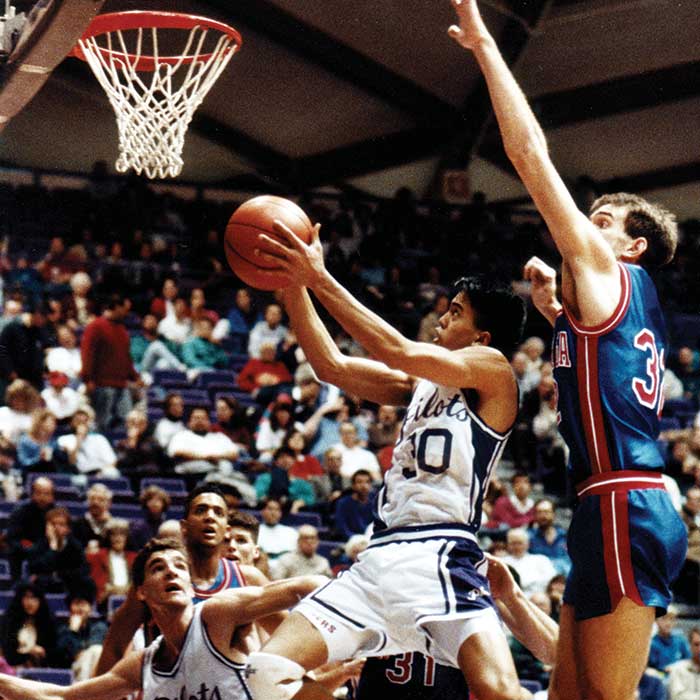
Erik Spoelstra playing for the Portland Pilots (UP Athletics)
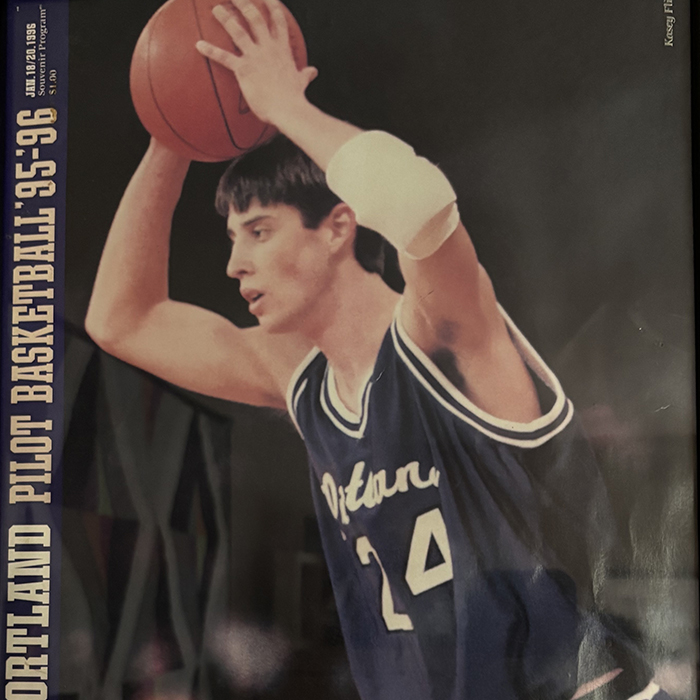
Kasey Flicker playing for the Portland Pilots (UP Athletics)
Miami Learning Experience & Sophie
SPOELSTRA WAS INTRODUCED to the special needs community roughly 10 years ago when one of his neighbors invited him to a fundraiser at the Miami Learning Experience, a school that provides a safe and peaceful environment for people with intellectual developmental disabilities. The highlight of the event was a fashion show, designed and created by the students, who put together a runway, picked out special outfits, and transformed themselves into models for the evening.
“It was spectacular,” Spoelstra said. “It blew my mind.”
He returned to the school a year later for another fundraiser and again the year after that, and before he knew it, Spoelstra was a fabric of the community. In 2018, he donated $50,000 to help fund a campaign to expand and renovate the school, and later hosted art benefits to raise money for students. A room at the school—The Spoelstra Family Art Room—honors his philanthropy.
Three thousand miles away in Portland, one of Spoelstra’s old UP buddies was growing attached to the special needs community through a different source: His daughter.
When Sophie was born, she was a happy and healthy bundle of joy, the second child and only girl of Kasey and Jami (Costello) Flicker ’96. When Sophie was four months old, Jami was folding laundry in her bedroom when she glanced over and spotted something she couldn’t believe. Her sleeping baby was fidgeting around, flexing her arms skyward, beset by what appeared to be tiny spasms. They were subtle, but Jami, a nurse, knew something was off, so she called Kasey at work in a rush. “Hey,” she said, “I think I just witnessed Sophie having a seizure.” Jami dashed to the emergency room, and Kasey bolted from work to meet them.
Twenty minutes after Kasey arrived, he and Jami were sitting in a private room at the hospital listening to a neurologist deliver life-changing news: Sophie had a rare and incurable genetic disease called Tuberous Sclerosis Complex (TSC), which causes non-cancerous tumors or lesions to grow in the brain and other areas of the body. Sophie was having hundreds of tiny seizures every day, and the infantile spasms were disrupting her cognitive development.
“My first feeling was, of course, immediate shock,” Kasey said. “But then I switched to fight or flight. And it’s always been fight for me. I just immediately asked, ‘What’s next? What do we do? When’s our next doctor appointment? Let’s get this going.’”
The first task was stopping the seizures, and the first treatment option was medication. It didn’t work. So around her second birthday, Sophie had to undergo brain surgery, the first of multiple procedures designed to end the seizures and rid her body of tumors. She underwent a second brain surgery shortly after her third birthday, then had two more surgeries to remove tumors from her kidney. Sophie’s seizures finally stopped, but they had taken a toll, severely delaying her development. The Flickers met with 12 medical specialists, including speech and fine motor experts, to help her condition. She didn’t walk until she was four. She didn’t talk until she was five.
Now, at age 18, Sophie is still largely dependent on Kasey and Jami, who quit her nursing career to become Sophie’s full-time caretaker. The mundane daily tasks that most barely ponder—bathing, tying shoes, making lunch, unboxing and completing craft projects—require help and attention.
Sophie likely won’t leave for college or live on her own. But she’s social, and she’s a beloved student. She loves the Miami Heat and her favorite player, Tyler Herro. She’s active in dance and sports—Sophie will be an Oregon delegate in the Special Olympics USA this summer—and she’s always smiling. She plays basketball like her dad.
Just after Sophie’s 13th birthday, country music artist Bryan Martin released a song titled “Beauty in the Struggle,” and it has quietly become a source of inspiration for Kasey. The song is about finding strength and a zest for life amid heartbreak and hardship, and one of its lines—“That girl, she’s the beauty in the struggle”—connected with Kasey, giving voice to the feeling of his experiences.
Since Sophie received her diagnosis, Kasey and Jami have dedicated their lives to raising awareness about the disease and advocating for wider inclusion of the special needs community. The Flickers organized annual walks to raise money to fight TSC. Kasey joined the Tualatin Youth Basketball board so special needs athletes had a voice. The Flickers served four years as presidents of the Oregon chapter of the TSC Alliance. They’re active in the Unified program at Tualatin High School, a fully inclusive sports and fitness program that intermingles students with and without intellectual disabilities.
“You have to embrace the sadness of the loss,” Flicker said. “Sophie hasn’t had the same childhood as neurotypical kids, and she will be living with us the rest of her life. You have to accept it and embrace it, try to make her as happy as possible and love her. You can’t get bogged down in the struggle, or you can’t see the beauty. The beauty for me is my relationship with Sophie and knowing there is absolute love in our family and trust and respect for who we are. There is love in the daily routine. And there are lots of people in this world who love her.”
The Strength of UP Friendships
THE GROUP OF former University of Portland basketball players gathers once a year in the shadows of Camelback Mountain or under the bright lights of Hollywood, arranging a trip around the Heat’s schedule and when Spoelstra will have an off day in Phoenix or Los Angeles. The reunions among old friends—Matthew Houle ’93, ’94, David Roth ’91, Dan Gray ’97, Flicker, and Spoelstra—always feature a little sun, a little basketball, and a whole lot of reminiscing.
They share the latest happenings in their lives, swap old stories about Steele and assistant coach Art Wilmore, relive the days of living in Kenna Hall, and lament how their bodies started changing at 50. They recommend podcasts to each other, preach about the power of meditation, which Spoelstra practices daily, and share deep, unabashed laughter. Then, the following day, they attend a Heat game, where Spoelstra patrols the sideline as coach and his four friends watch from the stands. For generations, The Bluff has shaped lifelong friendships and this group is but one unique example.
Flicker and Spoelstra just missed each other at UP, but their relationship stretches back to their 20s. They used to play summer pick-up basketball in the Portland area and grab dinner with mutual friends, and once volunteered together at a special needs camp at The Hoop in Beaverton. Then they went their separate ways, Flicker settling into a life with Jami, his college sweetheart, and Spoelstra diving headfirst into a legendary NBA coaching career.
They reunited during the Heat’s championship run in the early 2010s. Flicker was in the stands for a game during the fateful 2011 NBA Finals, when Dallas upset Miami, handing Spoelstra the most gut-wrenching defeat of his storied career. Then Flicker was in the stands again each of the following two years, when Spoelstra cut down the nets in celebration after leading LeBron James, Dwyane Wade, and Chris Bosh to back-to-back championships. Flicker will never forget riding around with Spoelstra and his friends in a rented van after the championship victories, ducking in and out of the back doors of clubs, savoring history. But even more, Flicker will never forget how Spoelstra, at the height of the pressure-cooker, made a point of asking about Sophie and her condition.
“Erik always found the time, even in the depths of the Finals, to learn more about Sophie and offer compassion and empathy to my situation,” Flicker said. “She’s 4, 5, 6 years old at that time. She’s having surgeries and going through development issues. It was a difficult time. And he always made sure to inquire about Sophie. That was kind of the beginning of what is now a real strong desire and genuine interest from him to support and shine light on these kids.”
Years later, Flicker—a two-sport athlete who played on the last men’s basketball team to reach the NCAA Tournament—hatched an idea for Spoelstra to accentuate his contributions to the special needs community. Why not host a basketball camp for Sophie and other special needs athletes during his annual summer visit to Portland? Spoelstra loved the concept, but with one notable tweak. “It might make sense to do something here (in Miami) with the Heat brand and then maybe bring Sophie out and make an experience out of it, give her something she’ll remember for the rest of her life,” Spoelstra said. They thought things over and Spoelstra green-lit the camp during a dinner with Flicker and Roth at Riccardo’s Ristorante in Lake Oswego.
“I’ve been inspired by this community since I saw those students put on that runway show,” Spoelstra said. “And I felt moved to try to create more awareness for other people, to create a similar experience. This community still needs more people thinking about inclusion and seeing how inspiring this community can be. And they still need a lot of support. It’s not just financial support. That’s part of it, helping with the schools and the centers is important. But it’s also about volunteering and giving of your time to make something special and create an experience for them. And that was part of doing something like this. Everybody shows up to this event in a certain way and then when they leave, they are changed forever.”
Spo’s Rise
THE STORY OF Spoelstra’s rise with the Heat is legendary and well chronicled. He was hired to be the team’s first video coordinator in 1995 and spent countless hours paying his dues in “The Dungeon,” a cramped, windowless storage room in the bowels of old Miami Arena that was converted into a makeshift office and the Heat’s first video room. (Spoelstra sometimes worked all night long in The Dungeon and also authored 25-page scouting reports for the coach.) Spoelstra’s maniacal work ethic and pursuit of perfection caught the eye of Pat Riley, and Spoelstra’s career surged under the Hall of Fame coach’s guidance; over a six-year period, Spoelstra rose from video coordinator to assistant coach to advance scout to director of scouting, often filling multiple roles at a time. Then, in 2008 at age 37, Riley handpicked Spoelstra to be his successor, making him the youngest coach in the NBA.
The rest, as they say, is history. But history often neglects to mention that Spoelstra’s journey started on The Bluff. He arrived at UP after willing himself into a star at Jesuit and quickly etched his name in the Pilot record books, earning the starting point guard job on day one and blossoming into the West Coast Conference Freshman of the Year. He went on to average 9.2 points, 4.4 assists, and 2.4 rebounds over his four-year career, during which he scored more than 1,000 career points and finished fourth on UP’s all-time assist list with 488. But Spoelstra’s time on The Bluff was defined by losing—the Pilots went just 28-84 in his career—and is perhaps most remembered for a tragic incident during a game at Loyola Marymount on March 4, 1990, when Lions star Hank Gathers collapsed near midcourt and later died from cardiac arrest. Spoelstra was standing less than five feet away from Gathers when he crashed to the court.
“I’ll never forget it,” Spoelstra said.
Likewise, four years of losing made a lasting impression on the fiercely competitive kid who spent his childhood summers in the basketball gym, shooting and charting those 30,000 jump shots. It has taken decades, but Spoelstra has finally found perspective in the struggle.
“I think part of being an athlete is learning how to manage all the different emotions,” Spoelstra said. “And struggle is part of it. And then learning how to persevere, develop some level of fortitude and not to make excuses or pass blame. It’s really just to hopefully build character. You can build it with success, but you certainly can build it from going through tough times if you treat it appropriately. When you’re 19, 20 years old, you think it’s the most important thing in the world. But there are lessons in disappointment and hopefully that sparks something to make you better the next time around. I learned a lot from my college basketball experience. We have used this saying here for a long time: Adversity develops your character, but it also reveals it. You see that time and time again. Like I said, at some point or another, you’re going to face some tough times and hopefully that reveals what you’re made of.”
Spoelstra revealed enough in defeat to catch the eye of a professional basketball club in Europe, and he went on to play two seasons for Tus Herten, a professional team in Germany. But like most 20-something-year-olds Spoelstra was unsure about his future. After his first season in Germany, he returned to Oregon and worked a summer job at Nike, boxing sneakers at a warehouse in Beaverton. All the while, he had a strong urge to coach, so he sent dozens of letters to colleges inquiring about vacancies and even applied to be the coach at Sherwood High School outside Portland. He didn’t hear a peep from any of the colleges, but Sherwood offered him the job.
“I accepted it and then a week later I was like, ‘No, I can’t do this,’” Spoelstra said, laughing at the memory. “I just wasn’t ready. I thought I was and then I started thinking about a practice plan and what I needed to do. And I had no idea. Plus, I was delusional—I still wanted to play. So I went back to Germany for a second year.”
The following summer, Spoelstra applied to be the Heat’s video coordinator and flew to Miami for an interview with assistant coach Dave Wohl. Spoelstra was the only applicant and aced the interview. The job was his. But, if not for his sister Monica, he would have declined the offer in favor of another stint in Germany.
“She called me and cursed me out,” he said. “She said, ‘You’ve been trying to get into coaching forever. If you pass this up, you’re never going to get back in.’ She really scolded me.”
The tongue lashing worked. Spoelstra moved to Miami and has been there since.
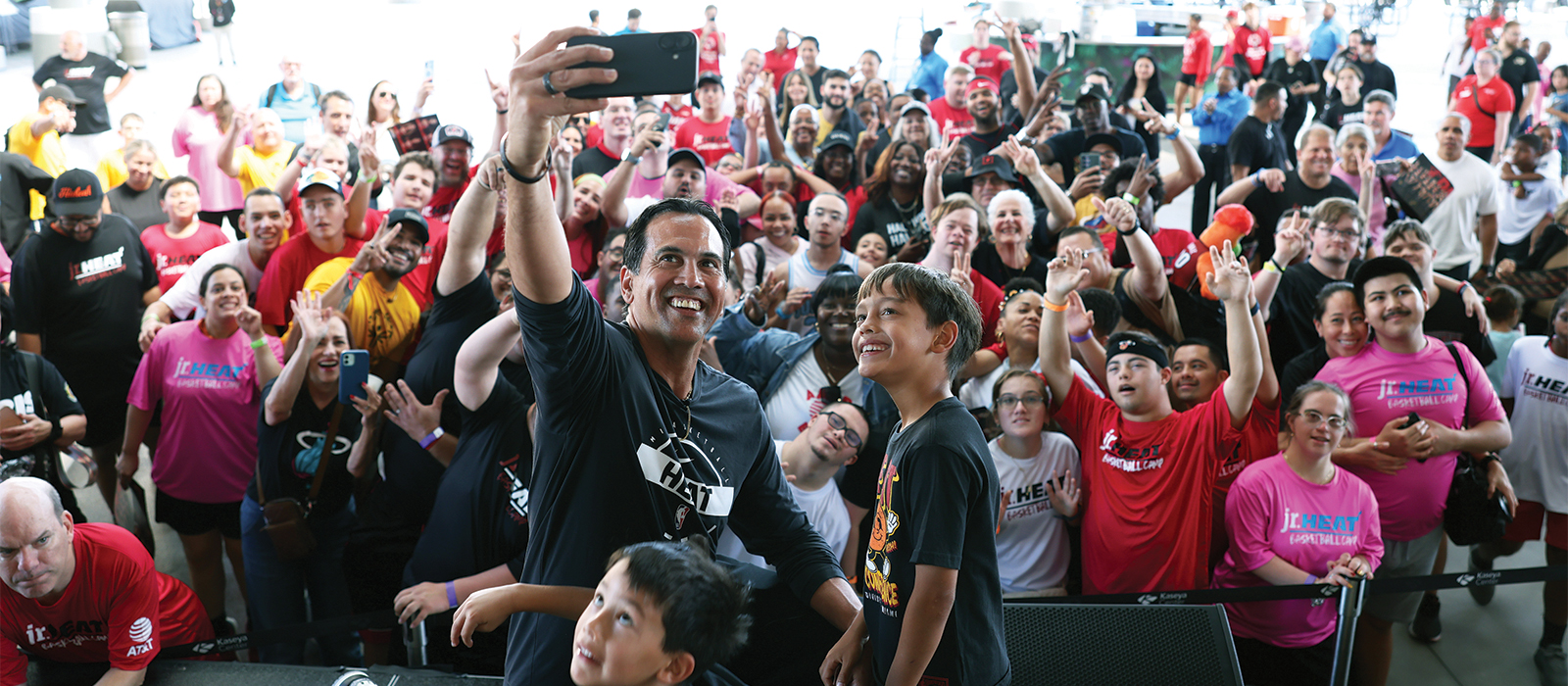
Erik Spoelstra pauses for a selfie with his sons and the athletes after the Heat Basketball Clinic (Heat Fan Photos)
Back in Miami with Sophie
SPOELSTRA SAT DOWN at a table in the plush family room at Kaseya Center and took a deep breath.
The camp had concluded, and it was a rousing success. In addition to the basketball activities, it included an outdoor rally overlooking Biscayne Bay, music and dancing, a chance to mingle with members of the Miami Heat dance team, and even a rare opportunity to take photos alongside the Heat’s three championship trophies.
“Man, what a day!” he said, beaming. “That was a lot of fun. But I have a few ideas for next year.”
Spoelstra wants to expand the camp to 200 athletes. He wants it to feature NBA-style introductions, during which the Heat public address announcer calls every participant by name over the arena loudspeakers. He wants family members to form a line near a tunnel and have campers stream down the middle of them onto the court as smoke oozes out of a smoke machine.
“I want to give them a moment where they get introduced, where they feel special,” Spoelstra said. “I want to make this even more memorable.”
Flicker and Spoelstra relived the day, debating what worked and didn’t work and imagining the future. The conversation eventually shifted to Sophie and how much she cherishes the event. Flicker expressed gratitude to Spoelstra for hosting the camp, giving this kind of an experience to Sophie and athletes like her.
Near the end of the day, Spoelstra climbed a platform to address the athletes and their families at the rally overlooking Biscayne Bay, and he took a moment to single out Kasey and his influence on the camp.
Sophie stood nearby, next to her grandmother, who had traveled with them to the clinic. When she heard Spoelstra give her son a shoutout, Kasey’s mother leaned over to her granddaughter. “Aren’t you proud of your dad?” she asked.
“Yeah,” Sophie replied, and a smile beamed across her face.
JOE FREEMAN ’99 is a senior writer for The Oregonian/OregonLive.