Kin
Best-selling author and botanist Robin Wall Kimmerer visited The Bluff and inspired listeners to care for the natural world
- Story by Jessica Murphy Moo
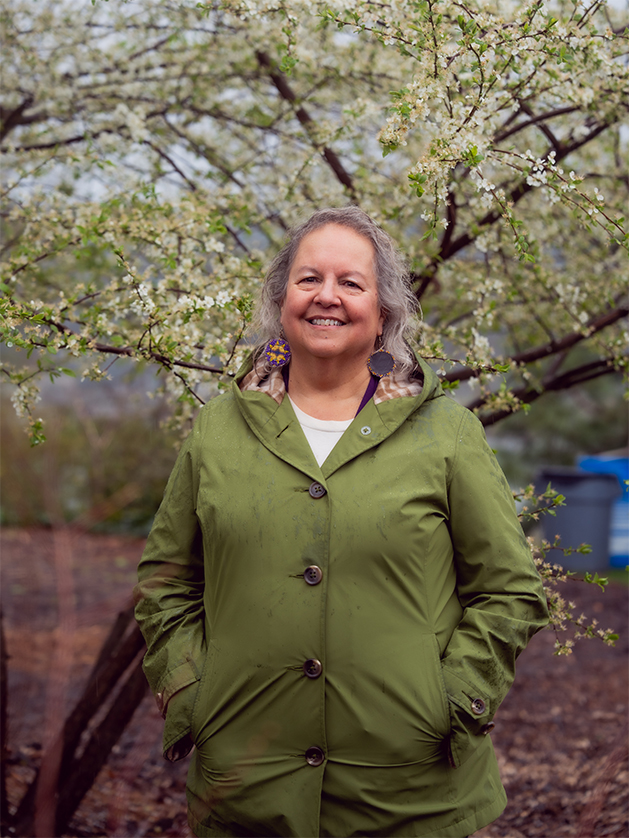
THE CROWD IN Buckley Auditorium was astonishing. I’d never seen anything like it at UP. Every single seat was taken, and when the overflow in the aisles started blocking the exits, campus safety directed people to Dundon-Berchtold Hall, where people filled another auditorium plus all the classrooms on the first floor so they could watch the event via livestream.
More than a thousand people—students, faculty, staff, and residents from all over the region—had come to University of Portland to hear the words of a botanist from upstate New York.
Her name is Robin Wall Kimmerer. Her book Braiding Sweetgrass: Indigenous Wisdom, Scientific Knowledge, and the Teachings of Plants is a national bestseller, and her message, consistent throughout her writing, is: The plants and the land and the natural world have sustained us through time. How are we reciprocating that gift? What are we giving back?
How inspiring to see so many people hungry for her message.
The day before, she’d been out on campus in the pouring rain for an initiative she calls Plant Baby Plant, which encourages people to engage in a culture of reciprocity by taking action, whether that’s planting a tree or growing a garden. Looking out over the Willamette River she said she was grateful to those who’d shown up to give back—the students working in the SLUG garden, the local nurseries in attendance, the students planning the native pollinator trail on campus.
Part of what’s really wonderful about working at University of Portland is that I’m always learning. Being around young people and smart professors and visiting scholars keeps my ideas and my thinking pliable. I’m always learning from new perspectives.
Robin Wall Kimmerer, for instance, asked everyone in attendance at her talk to think in new ways about the word “it.” In English we use the word to speak of things, and we include the natural world in the category of “things.” We might refer to a tree as an “it,” but never our grandma, for instance. Kimmerer is a member of the Citizen Potawatomi Nation, and in her tradition neither plants nor animals nor humans would be referred to as an “it.” In her language and in her belief system, there isn’t the same hierarchy of humans above other types of living beings. I hadn’t thought of the word “it” in this way before, how the hierarchy in the English language is connected to how we might treat the natural world. Of course they are connected.
She proposed using an abbreviation of an Indigenous word “ki” as a replacement. The plural of the word “ki,” appropriately, is “kin,” a beautifully relational word in more than one language.
Imagine how much stronger human and environmental communities might be if we considered one another kin.
After her talk, the line to get her signature snaked all the way out of Dundon-Berchtold Hall and toward Waldschmidt.
I didn’t get my book signed. But I did buy a bunch of tomato and zucchini starts to try my hand at a summer garden.
Consider coming back to campus for the next author visit in the Schoenfeldt Distinguished Visiting Writers Series. There’s always more to learn together.
More Stories
A Holy Chorus
A new icon of the women of the New Testament has been installed in Mehling Hall’s chapel
- Story by Cameron Bellm