A Holy Chorus
A new icon of the women of the New Testament has been installed in Mehling Hall’s chapel
- Story by Cameron Bellm
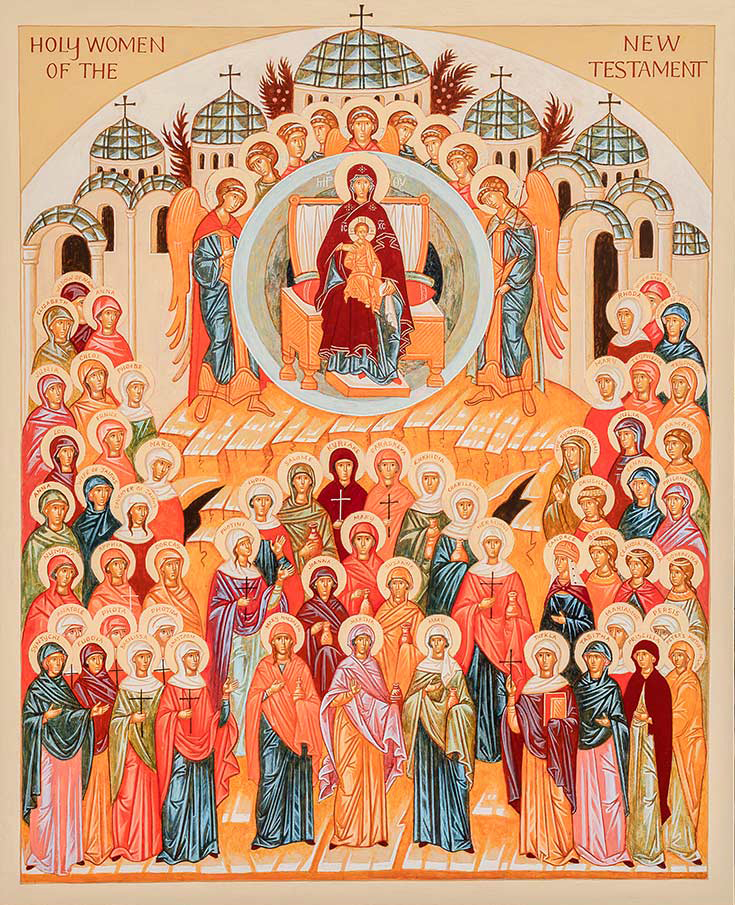
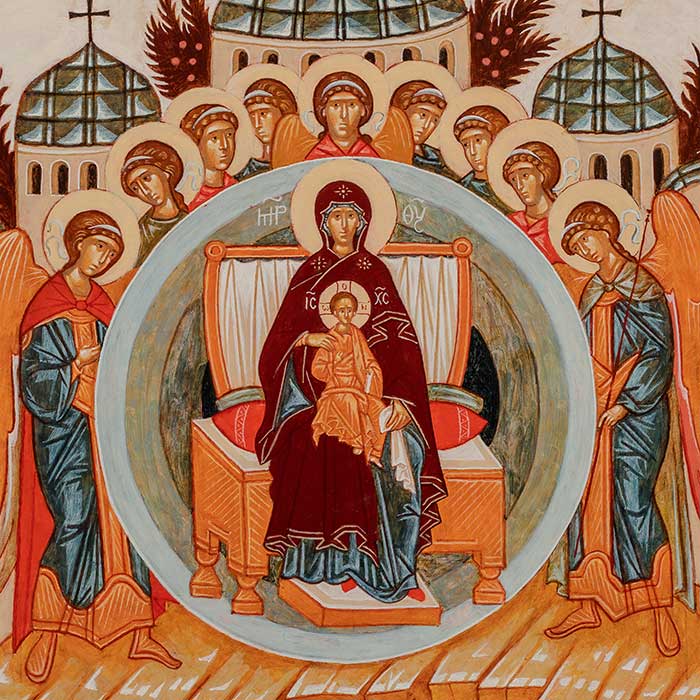
THE FIRST TIME I saw a photo of Heather MacKean’s icon of the women of the New Testament, I gasped. I wasn’t reacting to the icon’s bright and dynamic colors or its powerful architecture, which arranges the women like a holy chorus around the Mother of God. Although these elements are wonderfully compelling, I gasped for one simple reason: because there were so many women.
I had expected perhaps a dozen, running through the handful I could call to mind off the top of my head: Phoebe, Lydia, Junia, Priscilla. But this icon featured so many more. Fifty-nine in all.
I can’t say that I had ever considered the New Testament as a natural dwelling place for women. My mind went first to the apostles and writers of so many of the epistles that make up our Scriptures: Paul, Peter, James, Timothy. But as my eyes moved around the icon, taking in the names and faces of the women who played such important roles in the early church, I felt like I was witnessing their stories being restored to their proper place in our spiritual history.
There was one woman I was looking for in particular, one whose voice rings out in Scripture, one whose story creates a space for women in the work of evangelism: Photini. Her name, preserved and recorded in the Orthodox tradition, is derived from the Greek word for light, “phos.” You may know her better as the Samaritan woman at the well, whose encounter with Jesus takes place in John’s gospel. Her conversation with Jesus is, in fact, the longest one recorded in the New Testament. In MacKean’s icon, Photini is in the central group of women, clothed in deep purple, her arm outstretched with an open palm.
Sometimes the stories of women are flattened in Scripture. What I’d previously known about Photini’s story was no different. I didn’t know her name, for one. I only knew her as the woman with five husbands, now living with a man to whom she is not married. She has been erroneously considered a prostitute and is almost always defined more by her relationships with men than by her own inherent worth and dignity.
But her encounter with Jesus is truly revolutionary—it’s a deep one-on-one theological conversation, one that scandalizes his disciples. It’s a conversation in which Jesus communicates that Photini is seen and known, and yet not shamed or turned away. It’s a conversation in which she is assured that her questions are heard, that she is welcome in theological spaces.
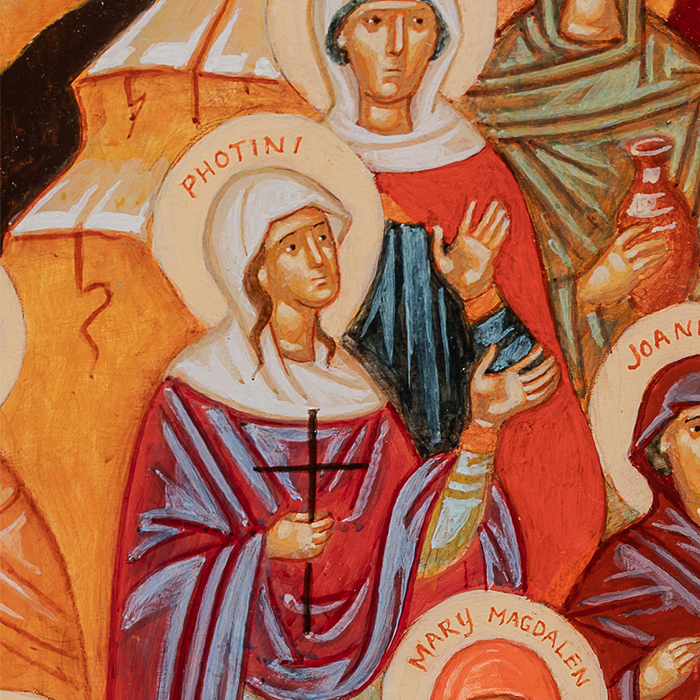
And then there are her actions after this encounter. Utterly transformed by her conversation with Jesus and his promise of living water, Photini drops her jar and sets off to tell everyone in town that she has met the Messiah. Photini is one of the first evangelists, and her title in the Orthodox tradition is, accordingly, Equal-to-the-Apostles. Orthodox hagiography records the details of Photini’s life beyond her conversation with Jesus in the gospel, and what a luminous life it was. Photini brought her five sisters into the faith, and they were all martyred by Nero. The emperor was especially enraged that his daughter Domnina, whom he had sent to convince the women to denounce their faith, instead converted and was baptized by them.
Before they were martyred, Photini and her sisters spent three years in a Roman prison. By all accounts of those who visited them there, the women created a bit of heaven on earth. The air was filled not just with the beautiful melodies of the hymns they sang, but also with the unmistakable scent of frankincense and myrrh. Photini’s sisters—Phota, Photida, Anatole, Paraskeva, and Kyriake—take their places in the icon, too, all of them bearing the martyr’s cross. Domnina looks on from the right, her role in the story of the early church also honored and memorialized. In a world in which women’s contributions are all too often overlooked or discounted, it feels like a holy act to learn their names and to speak them aloud.
As I contemplated the icon, I couldn’t help but think of the great cloud of witnesses mentioned in Hebrews. Here were 59 such witnesses, not just of the love and mercy of God, but of women’s essential role in the story of our faith. Among these preachers and prophets, missionaries and church leaders, I felt encouraged that there is a role for me there too.
CAMERON BELLM is a Seattle-based writer in the contemplative tradition. Her first book, The Sacrament of Paying Attention, will be released this winter.
More Stories
Serah’s Song
How one young woman from the Hebrew Bible used the healing power of music to transform her family’s story
- Story by Alicia Jo Rabins
Chapel of Christ the Teacher Turns 40
Today it’s hard to imagine University of Portland’s campus without its iconic chapel at the south end of the academic quad. The anniversary of its dedication—October of 1986—offers an occasion to pause and admire the staying power of its beauty, intention, and invitation.
- Story by Gigi Giangiobbe and Jessica Murphy Moo