Serah’s Song
How one young woman from the Hebrew Bible used the healing power of music to transform her family’s story
- Story by Alicia Jo Rabins
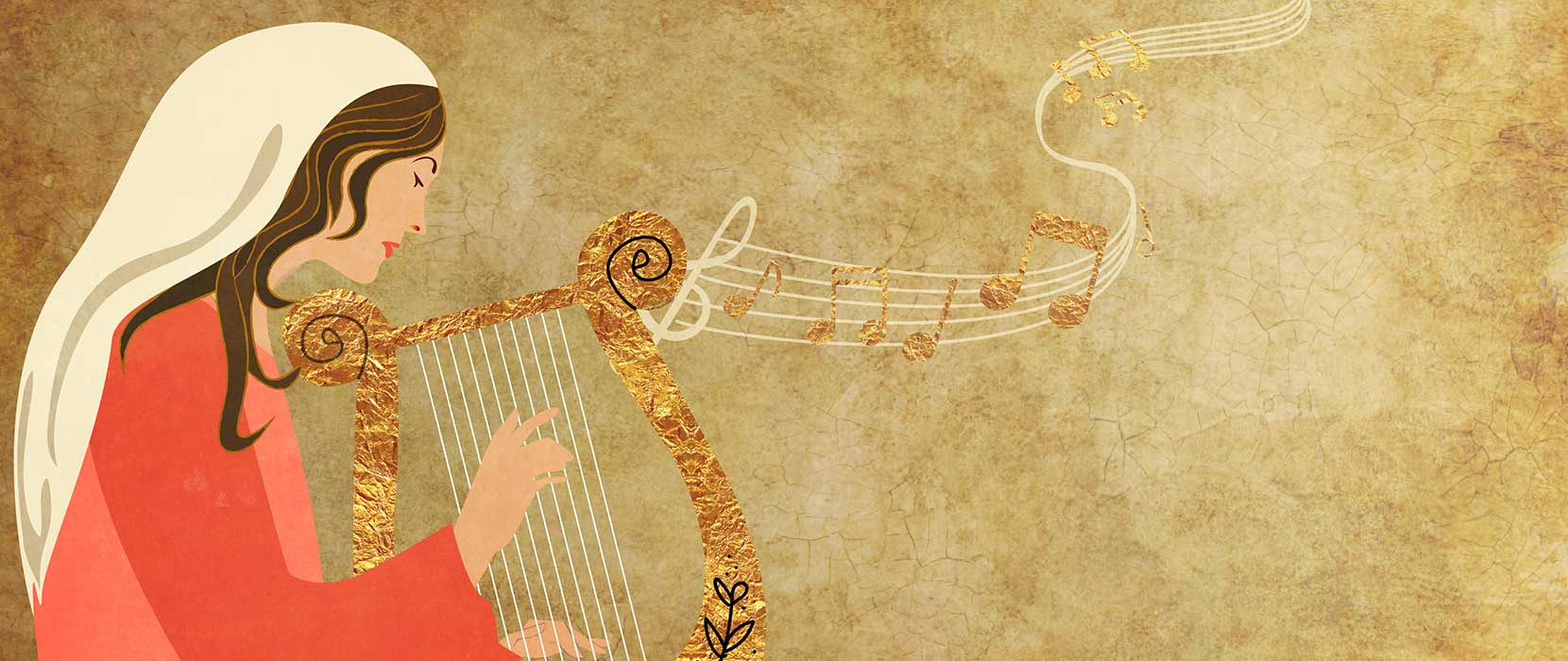
Illustration by Sefire Lightstone
SHE IS ONLY BRIEFLY mentioned in the Torah. But in rabbinic legends, Serah bat Asher expands to magical proportions; in a world of men, she becomes something of a quiet superhero.
In these legends, Serah has a range of connected powers, both creative and spiritual. She is a singer-songwriter who uses music to carry out a delicate, pastoral task; a wise woman who knows her people’s history intimately; a mystical character who possesses the ability to transcend death; and a holder of cultural memory who knows more than the rabbis themselves.
Her first extraordinary moment comes when she is a girl, or perhaps a teenager—and, despite her youth, the only one who can save her grandfather. Earlier in Genesis, Joseph’s brothers, jealous of his status as favored son, throw him into a pit and leave him for dead. One of these brothers is Asher, Serah’s father.
When the brothers return to their father, they lie about what happened to Joseph, saying, “Your beloved son has been killed by a wild animal.” In fact, though, Joseph has been bought by slave traders and sold in Egypt.
Years pass, during which Joseph’s brothers live their lives, and their father assumes his favorite son is dead. Then a famine hits the region. Joseph’s brothers travel to Egypt, to beg for food from the storehouses there. They’re received by none other than Joseph—who is not only alive and well, but has risen to become Pharaoh’s right-hand man.
Here’s where Serah comes in. Joseph reconciles with his brothers, and invites his extended family to move down to Egypt so that he can provide for them—but there is a problem. Their elderly father, back in Canaan, has long believed his favorite son to be dead. How can the brothers reveal the news that Joseph lives, without giving their father a shock that will kill him?
This situation cannot be solved with muscle; the superpowers needed are empathy, creativity, and nuance. And Serah possesses these qualities. She is a songwriter and a singer, and these skills give her the ability to save her grandfather’s life by delivering the information through art. She builds a song-shaped container to hold the news that Joseph is alive—and also to hold her grandfather’s grief and joy, so that it will not break his body.
Reading about Serah, I think about the close relationship between art-making, healing, prayer, and song. We are taught to separate these practices entirely: “religion” and “art,” “therapy” and “creativity,” “healing” and “music.” These paths, we’re told, require entirely different training: music conservatory (or art school, or theater school, or film school) versus rabbinical school (or seminary, or other spiritual training programs).
But are they really so different? All of these paths, whether we call them “artistic” or “spiritual,” create a container, a sacred space—a brief respite from everyday life in which we humans, so often overwhelmed with the details of getting through the day, can experience a sense of holiness and connectedness to ourselves and each other. Perhaps Serah’s song exists as a beautiful symbol of this profound kinship between art and spirituality, music and healing.
Serah’s story does not end here. In fact, according to rabbinic legend, it never ends. When her grandfather hears her sing, he understands that she has performed a miracle for him, and in exchange he blesses her with eternal life.
Her immortality enables her to become an oracle for her people, holding cultural memory across generations. Hundreds of years later, Serah will remember the location where Joseph’s bones were buried beneath the Nile—crucial information, since Joseph’s descendants, having previously promised to take his bones back to the Land of Israel, could not leave Egypt without them.
Many generations later, the midrash tells a story about Serah visiting the rabbis in the beit midrash. They’re debating the technicalities of how exactly the waters parted to allow the Exodus from Egypt when Serah suddenly appears to set them straight. She was there, she saw the miracle firsthand; and she corrects them, describing what actually happened.
Since the rabbinic-era beit midrash was limited strictly to men, the image of a female biblical character entering and correcting the rabbis is quite dramatic. Perhaps this story—written by the rabbis themselves—gestures toward the fact that they, on some level, understood the limits of the male-dominated scholarly tradition. Perhaps, in creating a Serah who can locate Joseph’s bones when Moses cannot, the rabbis are subtly (unconsciously?) acknowledging that any tradition which does not fully include women’s wisdom and lived experiences will have a compromised view of what it means to be human. It’s not easy to acknowledge that our own experience is limited; I admire the rabbis for passing down a version of Serah’s story that implies the limits of their authority and knowledge.
Serah is a quiet but powerful foremother. I love her radiant character, her multiple powers: her ability to use song as a healing medium, her confidence in the truth she has seen, and her mystically long—perhaps infinite—life.
Her abilities of perception, song, creativity, and communication are a beacon for the artist in each of us, the part of us that knows how to use our sensitivity to help others understand what we see. Serah is a model for trusting our own experience; honoring the healing power of art and spiritual practice; and making beauty out of what we know to be true.
ALICIA JO RABINS is a writer, musician, and Torah teacher. She is the creator of Girls in Trouble, an indie-folk song cycle about Biblical women, and the author of five books, most recently the spiritual memoir When We’re Born We Forget Everything.
-
From When We're Born We Forget Everything by Alicia Jo Rabins. Copyright (c) 2026 by Alicia Jo Rabins. Published by arrangement with Alread A Knopf, an imprint of The Knopf Doubleday Group, a division of Penguin Random House LLC.
More Stories
A Holy Chorus
A new icon of the women of the New Testament has been installed in Mehling Hall’s chapel
- Story by Cameron Bellm