Student Resources

Student Resources
Student Engagement
Eco Club (CEC) is a student-led organization that strives to increase environmental awareness on campus. Most major events organized by CEC are centered around outreach and education for the overall UP community. However, the club also attempts to spread the word about upcoming environmental events throughout Portland and the Pacific Northwest, and to help facilitate club members' participation in those events. CEC is in partnership with other on-campus groups like SLUG, PACOS, and the sustainability theme house.
For more information, interested students can email: collegeecology@gmail.com.
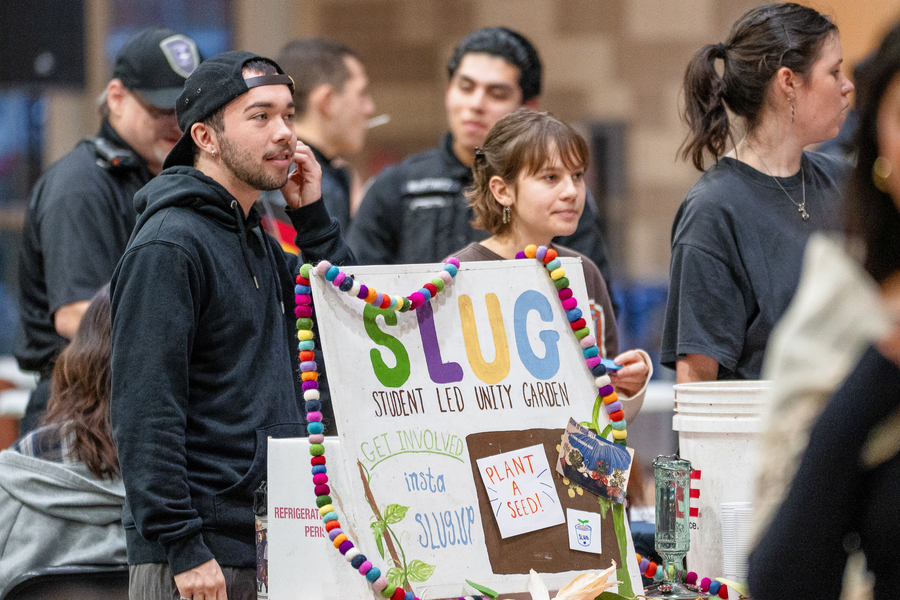
SLUG (Student-Led Unity Garden) is an organic, sustainable garden located on the University of Portland's campus in North Portland. The SLUG Project was started in 2006 by a small group of dedicated UP students, and the garden was built in the spring of 2007. In addition to providing organic fruits, veggies, herbs & flowers, the garden aims to help build a relationship between students, their food, the environment and the surrounding N Portland community.
SLUG has organized residence hall composting programs, cosponsored Focus the Nation, and taught dozens of students and community members how to grow organic sustainable produce.
If you would like more information on the garden or wish to participate in any way, please email: SLUGproject@gmail.com.
- Boise State University
- California State University-Monterey Bay
- Cal Poly Pomona
- Colorado State University
- Cornell University
- Evergreen State College
- Lewis & Clark Law School
- Loyola University Chicago School of Law
- Montana State University
- Northern Arizona University
- Oregon State University*
- Pacific University
- Portland State University*
- Texas A&M University
- The New School, NYC
- University of Alaska Southeast
- University of Arizona
- University of California Santa Barbara
- University of Denver
- University of Idaho
- University of Minnesota
- University of Oregon
- University of Portland
- University of St. Andrews, Scotland*
- University of San Francisco School of Law
- University of Washington
- Vermont Law School
- Washington State University*
- Western Washington University's Huxley College of the Environment*
*Attended by multiple UP graduates.
Goldwater Scholarship
The Goldwater Scholarship supports college sophomores and juniors who plan to build research careers in the natural sciences, engineering, or mathematics. If that describes you, this page walks you through what the scholarship provides, whether you are eligible, and how the application process works.
The Award
Up to $7,500 per academic year toward tuition, mandatory fees, books, and housing and meals — after other support you receive is considered. Sophomores may receive up to two years of support (four semesters); juniors may receive up to one year (two semesters) — or until graduation, if that comes sooner.
Eligibility:
- You are a currently or previously matriculated sophomore or junior at an accredited 2-year or 4-year U.S. institution and will be a full-time matriculated student during the academic terms when receiving scholarship support. Goldwater defines sophomores and juniors by the semesters remaining until your graduation.
- You intend to pursue a research career in a natural science, mathematics, or engineering. Careers in medicine, veterinary medicine, and engineering qualify only if research is central to your career goals.
- You have a college grade-point average of at least 3.00 on a 4.00 scale.
- You are a U.S. citizen or U.S. national from the 50 states, the District of Columbia, Puerto Rico, Guam, the U.S. Virgin Islands, American Samoa, the Commonwealth of the Northern Mariana Islands, the Republic of the Marshall Islands, the Federated States of Micronesia, or the Republic of Palau (or any other U.S. territory or possession) — or you are a permanent resident of the United States. Permanent residents must include a copy of their Permanent Resident Card (Green Card).
Hollings Scholarship
This prestigious scholarship provides students with an academic award of $9,500 per year for two years of full-time study and a 10-week, full-time, paid summer internship opportunity at any NOAA facility nationwide. The award also includes funding to present summer internship research at two national scientific conferences.
Up to $40,000, including:
- $9,500 stipend per year for junior and senior year
- A 10-week paid NOAA internship
- Funds for travel and conference participation
Eligibility:
- U.S. citizen
- Full-time undergraduate sophomore* at an accredited U.S. college or university
- 3.0 minimum GPA
- Major in NOAA mission fields, including STEM and social science
*Eligible applicants for the 2027 application cycle should have an anticipated bachelor's graduation date between December 2028 and August 2029. Community college students planning to transfer to a four-year university in Fall 2027 as an undergraduate junior are also eligible.
If interested in applying, please contact Cara Hersh. For additional information visit the Hollings Scholarship website.
Morris K. Udall Foundation Environmental Scholarship
This scholarship seeks to reward undergraduates with the commitment and potential to make significant contributions to the environment, tribal health and tribal governance.
General Qualities of Nominees:
Demonstrate commitment to improving or preserving the environment. For Native American and Alaska Native students, a demonstrated commitment to health care or tribal public policy. Potential for significant future contribution to his or her chosen field.
Who is the Typical Udall Scholar?
There is really no "typical" Udall Scholar. These scholars have a broad range of academic backgrounds and environmental, tribal governance, or health experience with an equally broad scope of potential careers.
Who is Eligible?
Only undergraduate sophomores and juniors may by nominated. Graduating seniors and first-year undergraduates are not eligible regardless of number of credits. Nominees must have a minimum 3.0 GPA. Nominees must be able to attend a mandatory Scholar Orientation Selection Process.
Applicants are reviewed using four principal categories:
- Commitment to improving or preserving the environment, or to health care or tribal public policy
- Personal characteristics - the criteria include activism, volunteerism, evidence of well-roundedness, and reference
- Essay
- Academic achievement
Please submit all nominations and a supporting statement to Cara Hersh. For additional information visit the Morris K. Udall website.
The Rev. Arthur Schoenfeldt, C.S.C., Award in Environmental Ethics and Policy is given to the student demonstrating the greatest commitment and accomplishment in their studies in environmental ethics and policy at the University of Portland. Awardees are honored at an awards ceremony, given a certificate, and have their name engraved on a awards plaque displayed at the University.
- Brian Olson 1999
- Scarlett Callopy 2000
- Sonia Frojen 2001
- Janelle Neva 2002
- Nicole Ulacky 2002
- Kimberly Arner 2003
- Emily Lewis 2004
- Andrew Maggi 2005
- Kary Coleman 2006
- Cassedy Sullivan 2007
- Lacey Riddle 2008
- Amalie Allers 2009
- Kelly Northcutt and Matt Dakopolos 2011
- Catherine A. Griffith 2012
- Molly Johnson 2013
- Alyssa Thornburg 2014
- Abigail J. Merrill 2015
- Yannika Marquardt 2016
- Eliot M. Jost 2017
- Abigail Kessi 2018
- Zoe K. Tapert 2019
- Lauren Compitello 2020
- Trudi Timperman 2021
- Sophia Truempi 2022
- Lauren Block 2023
- Sarah Jolls 2024
The Suzanne S. Fields Award in Environmental Studies is given to the student demonstrating the greatest commitment and accomplishment in environmental studies at the University of Portland. Awardees are honored at an awards ceremony, given a certificate, and have their name engraved on a awards plaque displayed at the University.
- Melanie Sharp 1999
- Brita Clothier 2000
- Jennifer Fortin 2001
- Ann Richter 2002
- Lara "Alex" Cyril 2003
- Kari Meiser 2004
- Rachel Beebe 2006
- Travis Petchell 2007
- Patricia Cubanski 2008
- Ingrid Hannon 2009
- Nathan Banet 2011
- Amanda E. Horvath 2012
- Sanoe Keliinoi 2013
- Steven King 2014
- Dana Coppernoll-Houston 2015
- Calli VanderWilde 2016
- Margaret E. Bruckner 2017
- Rhys Coffee 2018
- Shannon C. Hansell 2019
- Allison Nirmaier 2020
- Josie Hughes 2021
- Jack Clark 2022
- Hannah Pickens 2023
- Joey Lacktrup 2024
- Kerigan Bermani 2022
- Sheridan Todd 2023
- Parker Wilkerson 2024
- Julia Weinand 2022
- Ruby Whorton 2023
- August Stone 2024
- Zoe Villano 2024
- Christopher Karo 2024
Two Year Course Schedule
- ENV 110 - Earth Systems Science
- ENV 182 - Environmental Science
- ENV 200 - Perspectives in Env Studies
- ENV 314 - Resilience and Policy
- ENV 321 - Global Env Politics
- ENV 333 - Geomorphology
- ENV 337 - Geomorphology Lab
- ENV 370 - Do or Do Not: Saving Planet A
- ENV 391 - Andes to Anchovies
*This anticipated schedule may change.
- ENV 110 - Earth Systems Science
- ENV 111 - Natural Hazards of the Pacific Northwest
- ENV 320 - Political Ecology
- ENV 327 - Global Environmental Justice
- ENV 349 - Environmental Policy
- ENV 365 - Climatology
- ENV 381 - Climatology Lab
- ENV 383 - Environmental Geoscience
- ENV 384 - Remote Sensing and GIS
- ENV 400 - Integrating Seminar in Environmental Studies
*This anticipated schedule may change.
- ENV 110 - Earth Systems Science
- ENV 111 - Natural Hazards of the Pacific Northwest
- ENV 200 - Perspectives in Env Studies
- ENV 314 - Resilience and Policy
- ENV 359 - Glaciology
- ENV 367 - Climate Change Negotiations: The Road to the Conference of the Parties (COP)
- ENV 370 - Do or Do Not: Saving Planet A
- ENV 388 - Glaciology Lab
- ENV 408 - Innovation for Sustainability
*This anticipated schedule may change.
TBD
Going UP?
Go farther and dream bigger than you ever thought possible. Join a community that's on a mission to change the world for the better. New experiences are waiting.