College of Arts and Sciences
Shiley School of Engineering
School of Education
School of Nursing and Health Innovations
Will AI Take Your Job? CNN’s Clare Duffy ‘17 Weighs In
Humanity's Role in a Digital World
In a workforce that is rapidly being transformed by AI, humans and our unique skills continue to play a key role that cannot be replaced, according to CNN tech reporter and University of Portland (UP) alumna Clare Duffy ‘17.
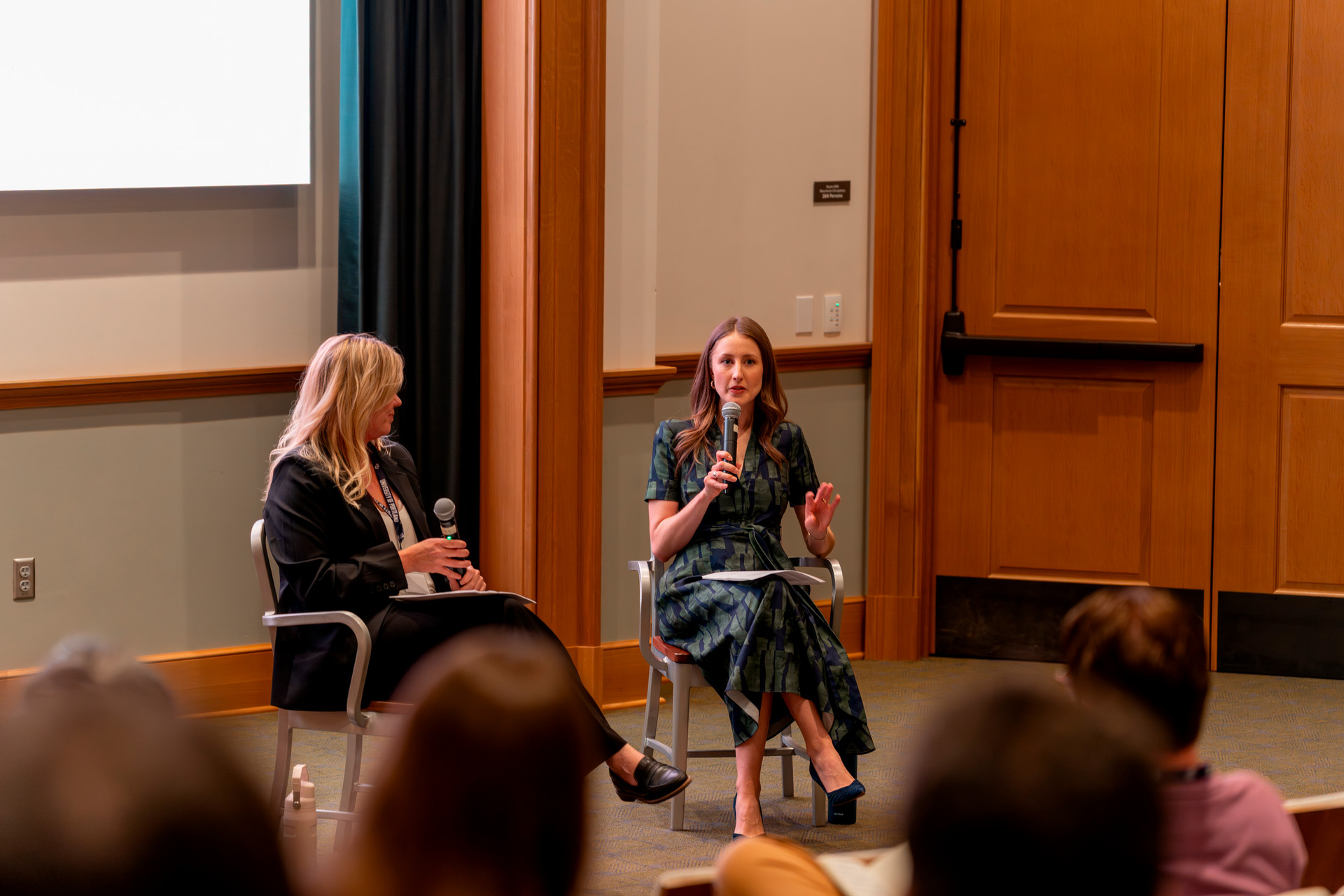
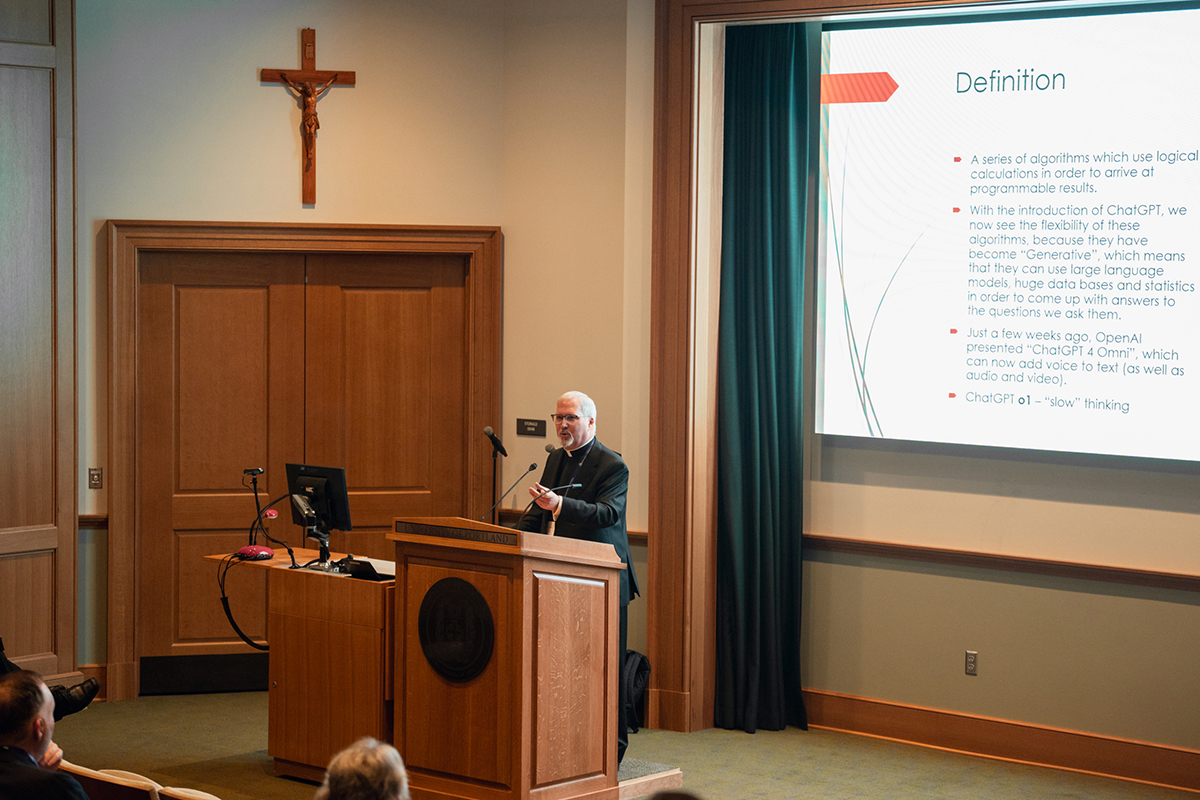
The host of the Terms of Service Podcast recently spoke at University of Portland as part of its second national AI conference, Catholic Education and Artificial Intelligence: Principles Educational Leadership for the AI Revolution. Led by UP’s AI-forward College of Arts and Sciences and the Dundon-Berchtold Institute for Moral Formations and Applied Ethics, the conference saw educational leaders and religious affiliates from around the nation converge on The Bluff to discuss the ethical, moral, and spiritual issues posed by artificial intelligence and its emerging role in higher education and the workplace. She was joined by Dr. Natalie Nelson-Marsh, an associate professor of communication and media at UP whose undergraduate course “The Future of Work” explores how we shape and are shaped by technological innovations in the workplace like artificial intelligence.
Numerous institutions have recently spoken about the importance of keeping humanity at the center of the AI discussion. Pope Leo’s XIV recent encyclical, Magnifica Humanitas, puts it plainly: “In the era of artificial intelligence, when human dignity is threatened by new forms of dehumanization, ours is the pressing duty to remain profoundly human. We must lovingly safeguard the grandeur of humanity bestowed upon us and revealed in its fullness in Christ, the splendor of which no machine can ever replace” (par. 15).
AI and the Future of Work
In her wide-ranging talk with Dr. Natalie Nelson-Marsh, an associate professor of communication and media at UP, Duffy addressed some of the rising concerns facing students and faculty in higher education today with regards to AI, offering some surprising takeaways and encouraging thoughts about how AI is changing the workforce and how everyone, from new students to longtime employees, can keep up.
1. AI Isn’t Taking Jobs—It’s Changing Them
It’s a common refrain, from Silicon Valley to LinkedIn: “In the future, AI will do everything.” Paired with a growing unemployment rate and the proliferation of AI models that can handle every task from writing an email to managing a corporate budget, it’s easy to feel like humans aren’t even needed to keep things running. But Duffy says this narrative is somewhat overblown. "Many of the thousands of jobs that have been lost in the past few months, where you have companies saying ‘we’re cutting jobs because of AI,’ is in fact because they have decided to allocate money differently, or they over hired during the pandemic, or the economy is challenging so they want to have a leaner workforce. Some of that is because of AI, but certainly not all of it. I think that’s important to understand.”
She also refutes the idea that AI is taking jobs: “In reality, what we're seeing is AI taking tasks that are part of people's jobs. And that may end up meaning that companies need fewer employees because some of those tasks have been taken away. But it is very difficult to automate an entire job because all our jobs involve some measure of speaking to other people [and] building relationships.”
2. Embrace Your Humanity
Duffy emphasized that as AI phases out certain elements of our work, human-centric skills like judgement, empathy, relationship-building, and delegation are going to be needed more than ever. “The thing I hear often from people in the tech world is that human judgement is going to be so much more important now that you have these tools do tasks, that the role of the human to direct those tools and to decide what kind of products to develop is going to be so much more important,” she said.
3. Understanding AI is a Job Requirement
In today’s workplace—regardless of your desired profession—knowledge of AI tools is as much an expectation for new employees as fluency in Excel or Word. “In many ways, companies expect young people, even more than their experienced workers, to understand this technology, because they look at [young people] like digital natives,” Duffy said. “The more they come in with those skills, the better prepared they are, because the thing that they lack is the human judgment piece that comes with experience.”
4. AI Can’t “Do It All” After All
“We’ve been told that [AI] is a general purpose technology that is good for everything—companies are starting to realize that that isn’t necessarily true. It is very good at some things. It is not necessarily good for everything.” Duffy said. She recalled an interview with the CTO of Airbnb, who was using 8-10 AI agents to handle work for him that would have traditionally gone to employees. What began as an exercise in downsizing and efficiency, however, made his job much more difficult; since AI agents never go off the clock, he was unable to, either.
“He said, ‘In many ways it’s more work for me and more overwhelming, because now I have a team of ten people that are working around the clock and coming back to me at random intervals.’ [...] I think we’re starting to see companies really ask, ‘where does this technology actually add value? Whereas, where do my human employees add value?’”
5. AI is Still a Work-in-Progress (That You Can Be a Part of)
Even though AI is moving at a rapid pace, Duffy said that there is now more opportunity than ever for users to be a part of AI’s progression, its implementation, and its future uses. “There’s a real opportunity for people at all levels [...] to be thinking about how we train students to enter into and have agency in a world that Silicon Valley would like for all of us to think is predetermined, when in fact we all do have a lot more control in terms of how we interact with this technology, what we’re asking of our elected officials in terms of how they regulate this technology, how we build data centers,” she said. “So, I think reminding students, regardless of what field they’re in, that they have an opportunity to contribute to this discussion, is crucial."
Watch the entire discussion with Marsh and Duffy from the 2026 Catholic Education & AI Conference
Related Posts
College of Arts and Sciences
Decolonizing Ecology: Robin Wall Kimmerer Visits University of Portland
College of Arts and Sciences
Faith and Service
UP to Host Second AI Conference in June
Alumni and Advancement
College of Arts and Sciences
Student Success