
University of Portland, Marketing Program Ignites Diagnostic Thinking
Ask Questions, Don’t Expect Easy Answers
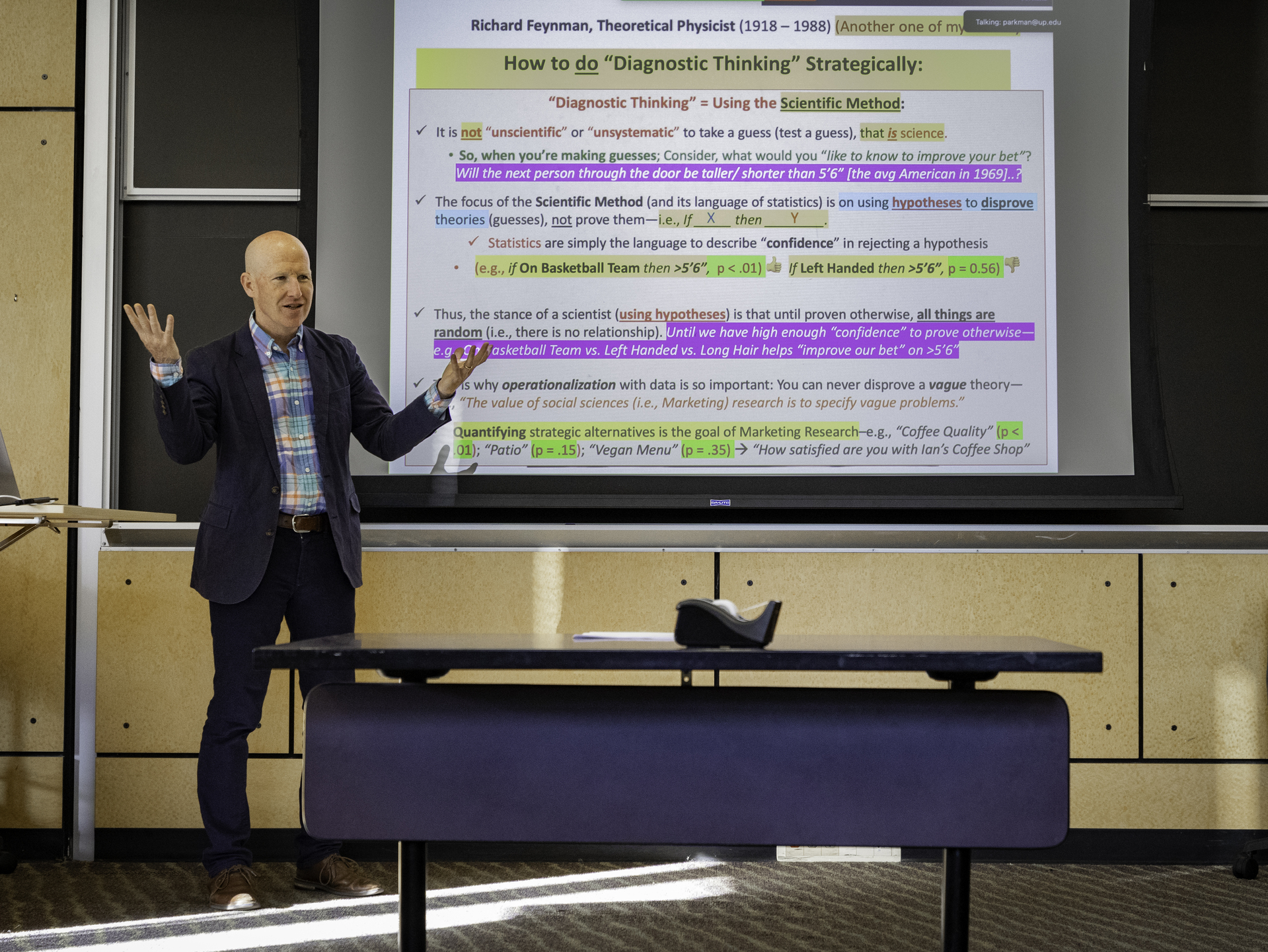
In a world of information overload, having access to data isn’t the issue—it’s knowing how to use it to your advantage. That’s why Ian Parkman, associate professor of marketing in University of Portland’s School of Business, takes his curriculum beyond analytics and gives his undergraduate and graduate students real-world training in diagnostic thinking: teaching them how to slow down, analyze complexities, and more effectively bridge the gap between business and consumer.
“Students today have no shortage of information. The real challenge is knowing what to do with it,” says Parkman, who has 15 years of teaching and research experience in design-driven product innovations, marketing strategy, and corporate identity at UP.
What is Diagnostic Thinking?
Parkman says most students are trained from an early age to jump straight from problem to solution. Before reaching the solution, there is a key step that is often missed. He said, “We condition students to respond quickly—write the essay, pick the right multiple-choice answer, move on—and then we’re surprised when, in the real world, they default to jumping at the first available solution. I push them to slow down and diagnose: What kind of problem is this? What’s driving it? What assumptions are we carrying without realizing it?”
Parkman’s work sits between design and strategy and much of his research focuses on the “value translation gap.” This is the space between what is intended and what is perceived. He said, “Most failures aren’t because the idea is bad—they’re because it’s misread, mis-framed, or aimed at the wrong need.”
For example, in his Sports Products course, students developed product line extensions for weighted training vests aimed at non-core users, like older consumers. The School of Business partners with OMORPHO for this class. It forces students to think in more holistic terms. Parkman says, “It shifts the conversation quickly—from “what features should we add?” to “who is this actually for, and why would they care?” It forces students to think in terms of holistic meaning, positioning, and relevance.”
Solving Marketing’s Wicked Problems: Real-World Strategy Consulting with adidas
Marketing work is steeped in a heavy dose of uncertainty. The possible answers to the questions being asked, don’t always come down to just one. Students need to be able to pick an option that they think works best. “In marketing, we deal with what are often called ‘wicked problems’—situations without clear criteria or single right answers,” Parkman said. “You say, “make red running shoes,” I say “make green”—who’s right? That’s the point. The work is in learning how to interpret situations, weigh tradeoffs, and make a case with some level of conviction. If students leave with a few frameworks, that’s fine. If they leave better at diagnosing problems—and a little more skeptical of easy answers—that’s the win.”
Parkman said, “In my BUS520 Marketing Strategy classes, students work on strategic consulting projects—most notably building go-to-market plans for adidas. Each team is paired with a current adidas employee in the business unit they’re interested in, who acts as a client mentor throughout the semester. The work is ambiguous, the feedback is real, and yes—it can be tough. That’s the point. You don’t build judgment in clean, controlled environments.”
Global Perspectives: Marketing and Design Study Tours Abroad
Beyond projects, School of Business offers experiences that push students to interpret, not just observe. This requires getting to know consumer culture, which is hard to do without exposure to diverse markets. Parkman said, “Over last Spring Break, we took a group to London and the UK.”
Students were able to experience running as culture and identity through Run Dem Crew; gaining insights on how to balance performance and design-based with SOAR Running; and understanding how consumer research shapes product strategy with the adidas Brand Insights team. They even got to study the co-evolution of history and product design at Cambridge’s Fitzwilliam Museum and the Engineering Design Centre. “Very different contexts—but together, they start to show how products, culture, and meaning intersect,” Parkman says.
Parkman said, “It’s learning how to make sense of what you’re seeing—and then take a position. That’s the real skill: not just having ideas, but being able to sell them clearly, credibly, and with conviction.”
Why Study Marketing at University of Portland?
Many programs teach marketing as data and analysis. However, at the University of Portland, while those skills are also part of the curriculum, leadership, and value systems are also integrated throughout. Markets don’t just respond to value, they respond to how value is framed and communicated, which is part of what UP teaches. Parkman said, “The ‘best’ products don’t automatically win. That’s a hard lesson, but it’s a useful one. Its oftentimes not the thing but what the thing means to a consumer. The question we keep coming back to isn’t just: Is this a good idea? It’s: Can you get other people to see it that way? If that feels a little uncomfortable, good. That’s the work.”