School of Education
Student Success
Alumni and Advancement
Graduate School
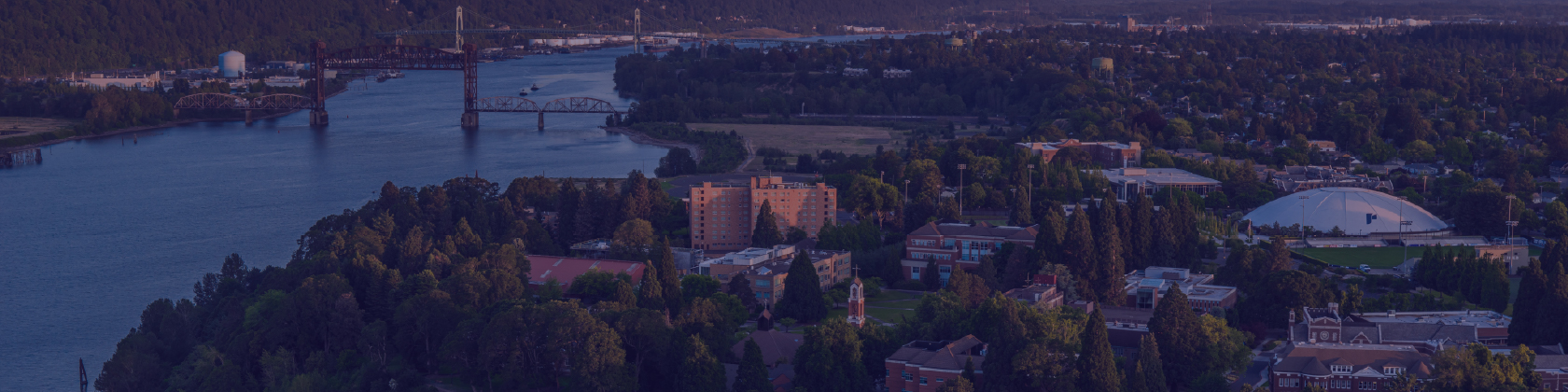
UP-Hosted Conference Advances AI Exploration; Propels Pope’s Letter
 In a world filled with uncertainty, it’s good to know you’re on the same page as the Pope.
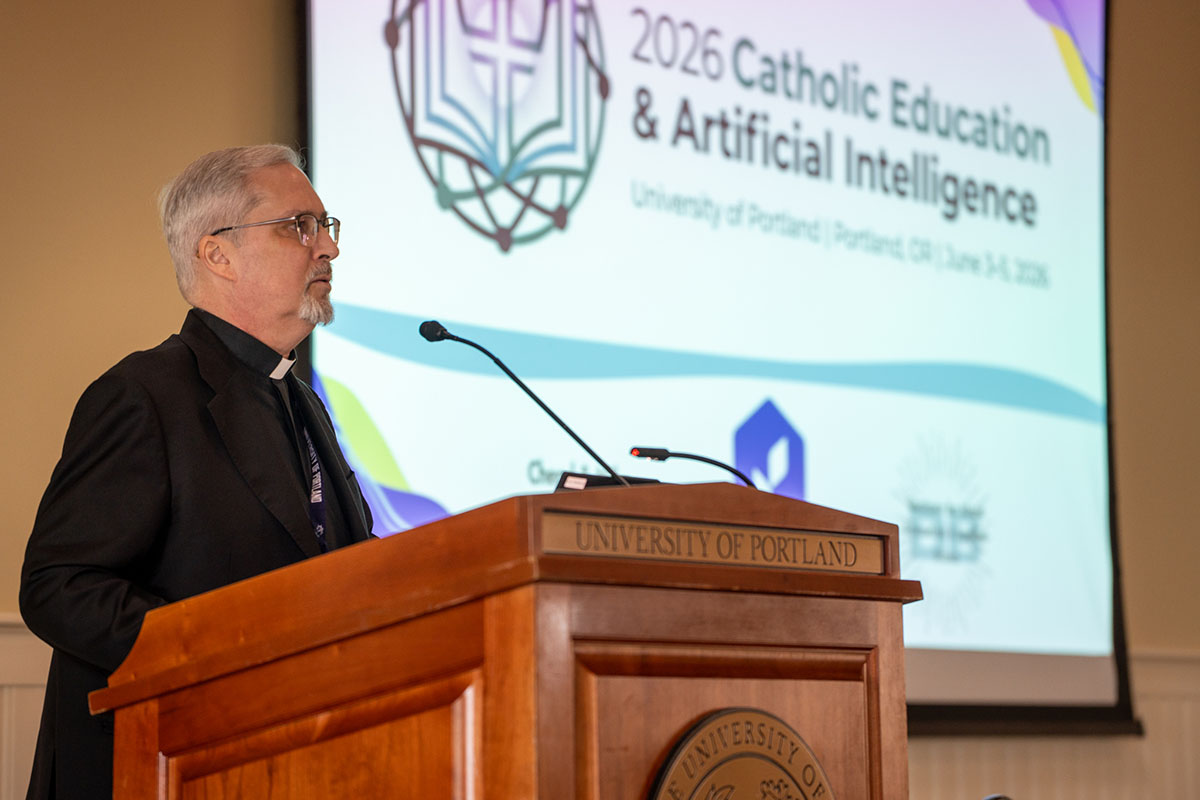
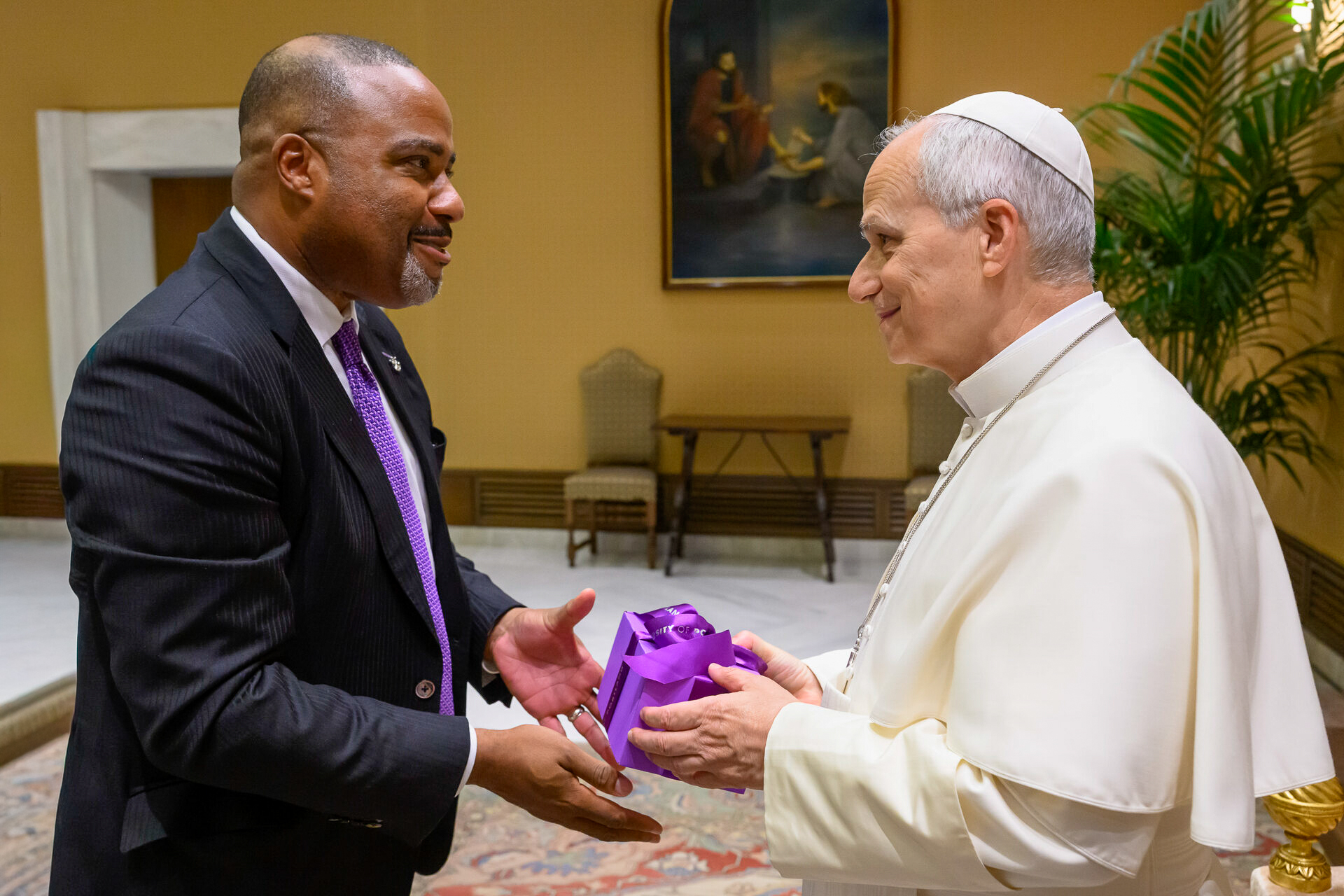
On Wednesday, June 3, just a week after Pope Leo XIV published his first encyclical, Magnifica Humanitas: On Safeguarding the Human Person in the Time of Artificial Intelligence, President Robert D. Kelly, PhD, was honored as one of 22 U.S. Catholic higher education leaders to have an audience with the Pope in Rome. That very same day, University of Portland welcomed faculty, administrators, and religious affiliates from 21 Catholic colleges and universities to campus for its second national conference on artificial intelligence.
The timing could not have been more harmonious. Mere hours after the Pope advised Dr. Kelly and his fellow delegates from the Association of Catholic Colleges and Universities (ACCU) that “It is critical that young men and women learn to engage positively with new technologies,” UP hosted thought leaders, themed sessions, and workshops for a deep dive into Principled Educational Leadership for the AI Revolution.
The three-day conference built on foundational learnings from the first UP-hosted AI education conference in the fall of 2024. Twenty months later, the follow-up gathering emphasized interactive workshops and specialized learning tracks exploring ethical AI integration in a rapidly evolving world.
Ronnie Delos Santos ’26, who published AI research on his way to earning his computer science degree in May, joined two UP classmates and Associate Professor Martin Cenek, PhD, to lead a session called Building Better AI Tools for Students to Learn.
“The way that I see AI, it’s like autopilot on a plane,” Delos Santos said. “Students are like pilots. They should know how to use autopilot, and they should know when not to use it. There are times when you should take control of the plane—take control of your learning—and not just rely on AI autopilot.”
Fr. Philip Larrey, PhD, a Catholic priest and philosophy professor at Boston College, delivered the opening keynote, The Philosophy of Artificial Intelligence. He called the UP-hosted conference “an important and timely event,” adding, “Things are happening so quickly in the sector, it is difficult to keep up. It is our obligation as educators to discern the good aspects from the negative aspects of AI.”
At the beginning of each semester, Fr. Larrey is clear with his Boston College philosophy students: “Don’t reject AI. Don’t misuse AI. Don’t draft off AI.”
“I put an emphasis on critical thinking, creativity, originality, hard work, and effort, which I know sometimes is not easy to do, but it’s the only way to learn,” Fr. Larrey said.
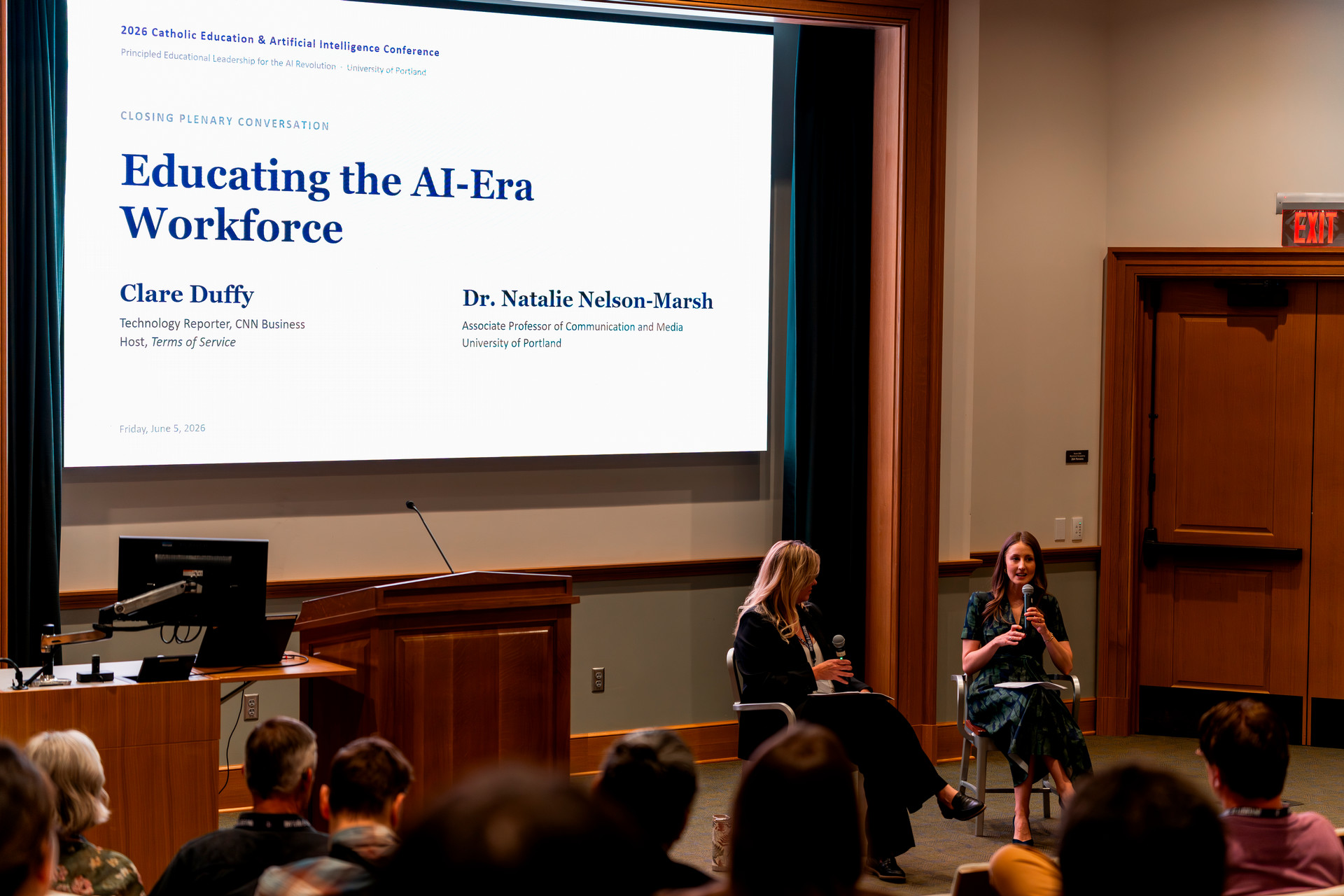
To close out the three-day gathering, UP alumnus Clare Duffy ’17, a CNN Business tech reporter and podcast host, joined UP Associate Professor Natalie Nelson-Marsh, PhD, for a conversation about Educating the AI-Era Workforce. Duffy said many conversations emerged from the three-day conference about how to apply values to the AI-related work that students will be doing in their careers after college.
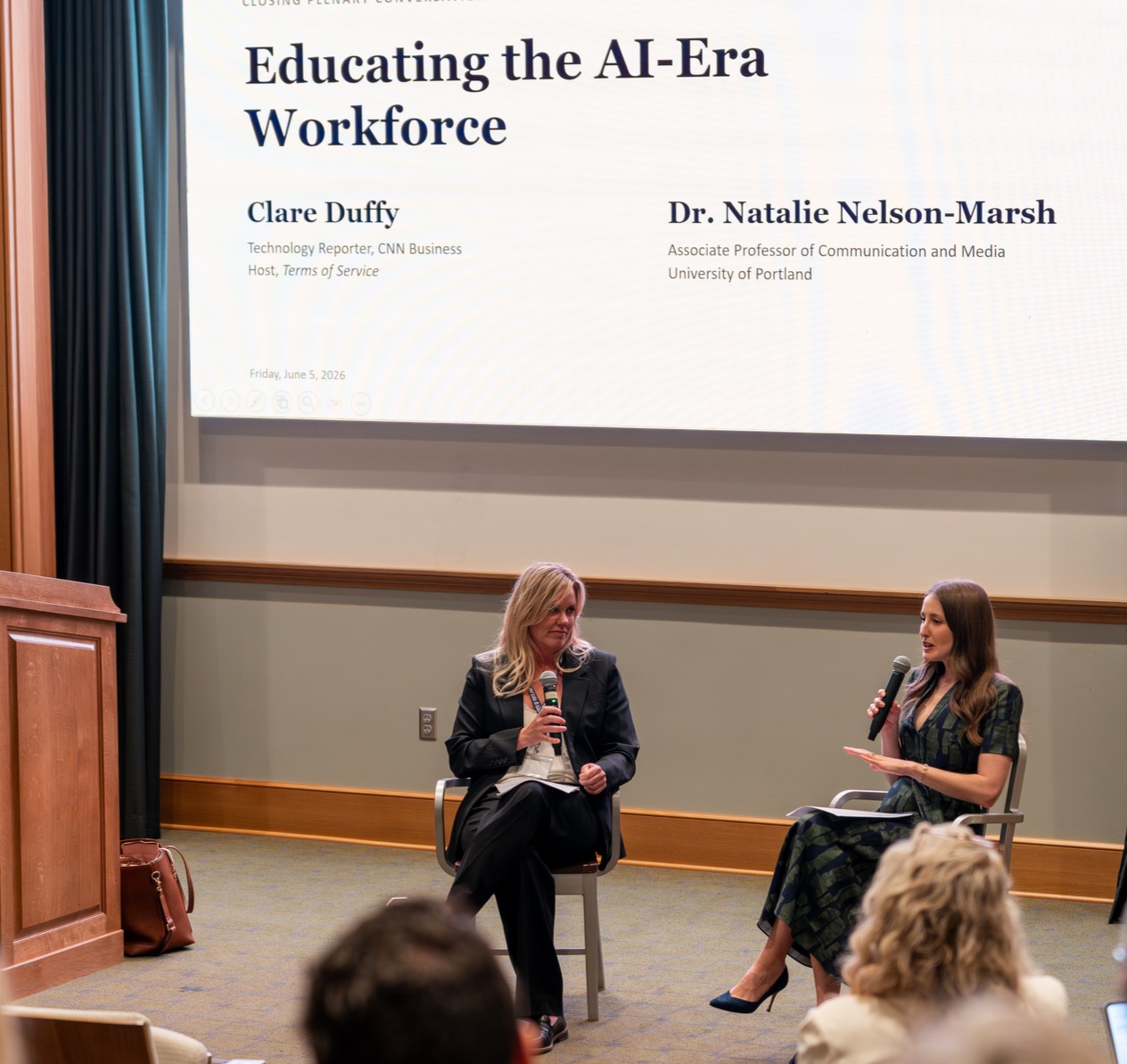 “What happens when they get out into the workforce and confront the forces of capitalism—which often have very different incentives? How do you bring along those values?” Duffy asked. She said top Catholic institutions like UP are not simply training workers to use AI tools — but raising future leaders who will shape policies to help society thrive with AI.
“For students, there is an opportunity to think about the kind of world they want to build. What does that look like? How can you take advantage of the very smart people on this campus, your professors, but also your fellow students, and talk about the kind of world we want to create when we leave the university?”
Nelson-Marsh, who just wrapped up her second year teaching UP’s AI-forward “Future of Work” course in the College of Arts and Sciences, said she teaches students to recognize patterns in how AI is shifting work so they can ask the right questions and be prepared for “a dynamic moving target.”
“There need to be humans in the loop—humans in the room,” Nelson-Marsh said about AI’s growing impact. “But it’s going to take work to keep us in the loop.”
Related Posts
School of Business
Alumni and Advancement
UP Launches Accelerated 3-Year Business Degree Pathway
Graduate School
Alumni and Advancement
School of Education
Rising to the Challenge: Lessons from a Graduate Student’s MAT Journey
College of Arts and Sciences
Alumni and Advancement
Will AI Take Your Job? CNN’s Clare Duffy ‘17 Weighs In
Related Posts
Office of the President
UP Remembers President Emeritus
Office of the President
Nearly Half of Portland High Schools Graduating Class Commits to Attend UP
Office of the President
UP President Robert Kelly Meets Pope Leo XIV in Rome
Office of the President