- Home >>
- Moreau Center >>
- Faculty Resources
Moreau Center: Faculty Resources
LinkUP
Moreau Center to Offer Service Grants For New Service Learning Experience Model- Link UP
Link UP grants will provide support and funding for new collaborative service-learning experiences that offer students, faculty, and staff the opportunity to engage in service and conversation around local, domestic, and international issues in a context of intentional integrated learning. New Link UP service-learning opportunities will offer a greater opportunity for collaboration between students, staff, and faculty with all aspects of the experience, formation, ideas, and organization, coming from faculty/staff and students themselves.
Like all Moreau Center programs, Link UP service-learning opportunities must have a clear focus on social concern, must identify clear learning outcomes, and incorporate the Moreau Center Core Commitments of direct-service, social justice, community, solidarity, reflection, spiritual exploration and sustainability. Accepted Link UP proposals will receive a Link UP grant of up to 50% of the total program cost, with a maximum grant of $5000.00 in addition to receiving organizational support and advisement from the Moreau Center.
Link UP Proposal Form
Link UP FAQ
Service Learning
SL and CBL Request Form CBL Agreement TemplateService Learning and Community-Based Learning Support requests must be filed at least one month prior to course start date.
Key Concepts for Service-Learning
Download a printable PDF hereThe Moreau Center for Service & Leadership maintains relationships of varying levels with over 200 community partners. These relationships and our experience supporting academic and co-curricular service-learning, internships and volunteer experiences in the Portland metro area are a valuable resource for both our campus and community. We work hard to keep our knowledge of community concerns, partner needs, and quality of student experiences current in order to effectively support faculty members interested in developing community-based or service-learning courses. Below are key concepts related to community-based and service-learning as defined by the Moreau Center for Service & Leadership.
Service-Learning
Jacoby, B. (1996). Service-learning in higher education: Concepts and practices. San Francisco: Jossey-Bass Publishers.Service-Learning is a form of experiential education in which students engage in activities that address human and community needs to together with structured opportunities intentionally designed to promote student learning and development. Reflection and reciprocity are key concepts of service-learning.
Cipolle, S. B.,. (2010). Service-learning and social justice : Engaging students in social change. Lanham, Md.: Rowman & Littlefield Publishers.Alluded to in the definitions above and articulated by Campus Compact, one of the national leaders and supporters of service-learning in higher education, are the “4 Rs,” a criteria for service-learning: respect, reciprocity, relevance, and reflection. Service-learning is not simply assigning community service as part of a course. It requires a significant amount of relationship development with a community partner, identifying a clear need, developing projects or programs to meet that real need and reflecting on the experience. Academic service-learning specifically connects the service to course content and learning outcomes. The service and community-based experience serves as a course text. Academic credit is for learning, NOT for service. Evaluation of learning can be through projects, papers, presentations or other tools.
Service-learning is a learning strategy in which students have leadership roles in thoughtfully organized service experiences that meet real needs in the community. The service is integrated into the students’ academic studies with structure time to research, reflect, discuss, and connect their experiences to their learning and their worldview.
The National Youth Leadership Council offers the following example highlighting the difference between SERVICE, LEARNING and SERVICE-LEARNING:
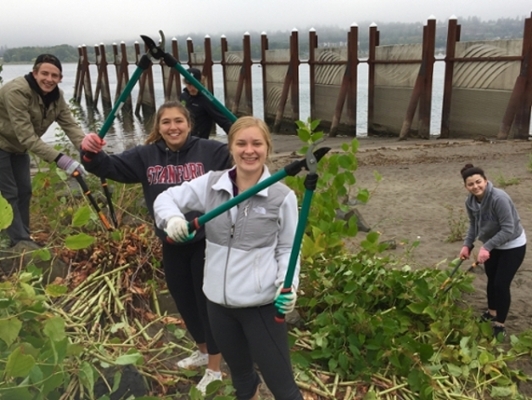
- Cleaning up a riverbank is SERVICE.
- Sitting in a science classroom looking at water samples under a microscope is LEARNING.
- Science students taking samples from local water sources, then analyzing the samples, documenting the results and presenting the scientific information to a pollution control agency is SERVICE-LEARNING.
- Science students creating public service announcements to raise awareness of human impact on water quality in order to change community attitudes and behavior is CRITICAL SERVICE-LEARNING.
STUDENTS: Best Practices for Service-Learning Assignments
Download a printable PDF here- Thoroughly look at your organization’s website and/or talk with people that have volunteered or worked with them in the past. Become especially familiar with the organization mission, program offerings, and staff.
- There’s a difference between community service and service-learning. You’re not just putting volunteer hours in, you’re engaging in meaningful hands-on service that hopefully meets real needs in our community and integrates with course objectives.
- Go in with a clear understanding of what your course objectives and the community partner’s needs are. Make sure you’re on the same page with your site. Preferably have a written memorandum of understanding or summary e-mail that you can refer back to later. Be clear if this is your responsibility, the community partner’s, your professor’s or the Moreau Center’s.
- Non-profit and community organizations are often under-resourced, under-staffed and overworked. Do your best to work around the community partner’s program and scheduling needs. Treat organizations and the individuals they serve with the respect of a professor.
- Phone calls or in-person conversations are often better than e-mail. If you e-mail to make a connection, follow up with a phone call or if an organization is not responding to an e-mail, trying calling or stopping by. E-mail is great to summarize what you heard in a conversation.
- A key component to a quality service-learning experience is reflection. Jot down notes after each site visit so you have something to refer back to during class discussions, presentations or written assignments. Note significant challenges, positive experience and anything you noticed related to course-related concepts. Go in looking for things to reflect on!
- Most youth placements will require a background check. The cost depends on the depth of the required process and subsidies available to pay for it through the organization. If you are asked to pay for a background check and cannot afford it, please contact the Moreau Center and we can assist you.
- The Moreau Center has cars available and offers free bus tickets if you need help with transportation to a service-learning site. Please stop by, e-mail moreaucenter@up.edu or call x7132 for more information.
- If at any time, your placement is not working out, or there is a difficulty you would like assistance with (even if you didn’t find the placement through our office), please let your professor know or contact the Moreau Center immediately. Don’t wait until debriefing in class or until a small problem gets BIG.
-
- moreaucenter@up.edu
- 503-943-7132
- Directions & Maps
- 5000 N. Willamette Blvd., Portland, OR 97203-5798
- © 2013 University of Portland, All Rights Reserved