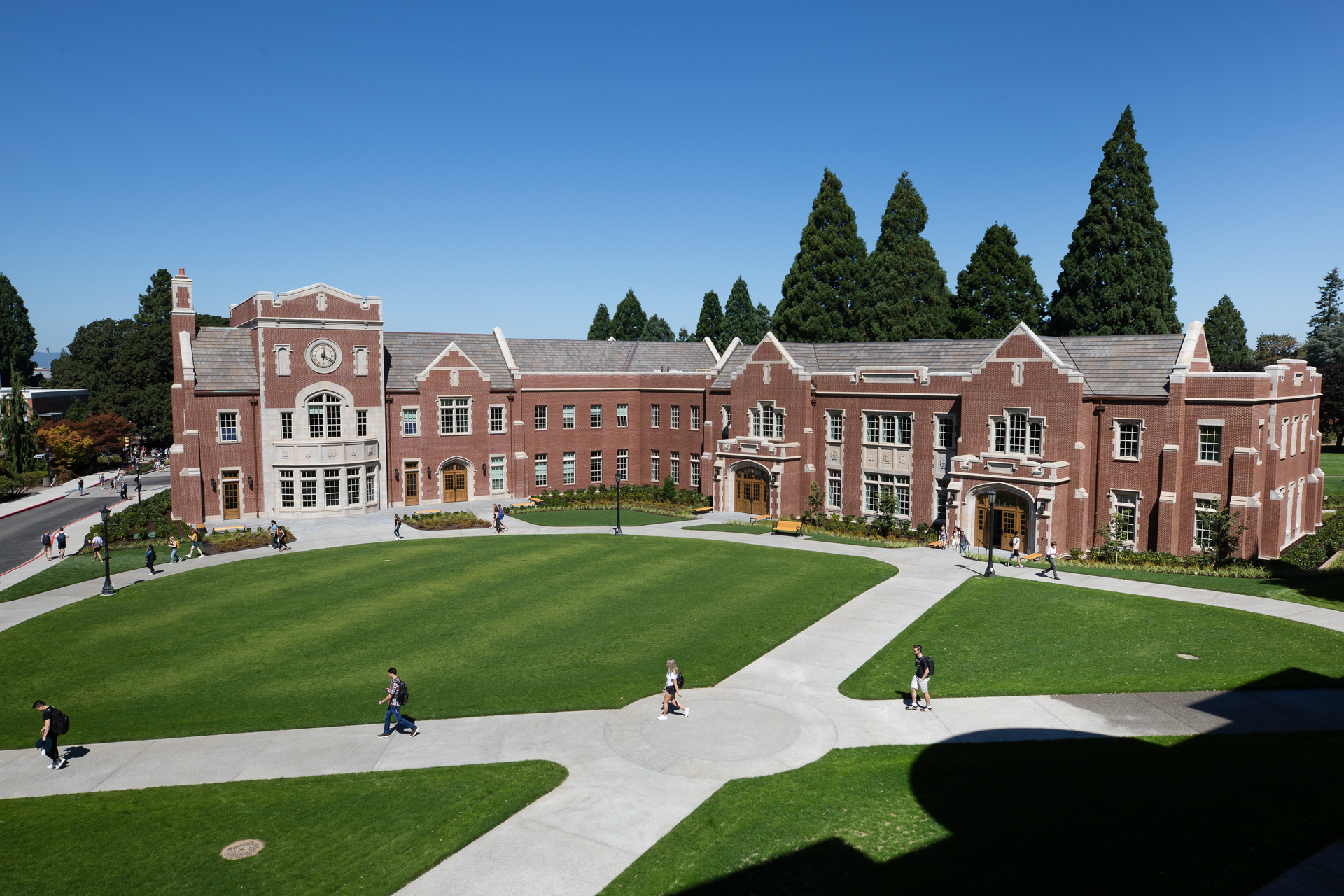
Admissions: Frequently Asked Questions
About the University
Where does the University rank among other schools?
U.S. News and World Report ranks the University of Portland among the West's top 10 regional universities, based on its excellent academic reputation, selectivity of admission, freshmen retention, student/faculty ratio, graduation rate and campus resources. It also is considered by the magazine to be one of the west's "best values" for providing an excellent education at a reasonable cost. The University of Portland ranked first nationally among master's institutions in a listing of top producers of Fullbright Awards for U.S. students in 2010-11. Washington Monthly magazine ranked the University of Portland first in the nation among master's universities for commitment to community service in 2011. University of Portland ranked number 3 on Peace Corps' 2011 rankings of colleges and universities with less than 5,000 undergraduates.
How much is tuition?
Full-time undergraduate tuition for 2012-2013 is $35,120 per academic year; other fees may be assessed depending upon the student's major. Typical room and board is $10,606 per academic year.
What religious denomination is the University of Portland affiliated with?
The University of Portland is Oregon's Catholic University. For a century it has been affiliated with the Congregation of Holy Cross, an order of Catholic priests and brothers that fosters the ideals of teaching, faith, and service to God and neighbor. About half of our students are Catholic. Students of all religious backgrounds are invited and encouraged to apply for admission to the University.
What is the University of Portland's Equal Opportunity and Non-Discrimination Policy?
The University of Portland does not discriminate on the basis of race, color, national or ethnic origin, sex, disability, age, or any other basis protected by federal, state, or local law in its educational programs, admissions policies, scholarship and loan programs, athletic and other school-administered programs or in employment.
The designated coordination point for University compliance with Section 504 of the Rehabilitation Act of 1973 and for ADA is the Executive Vice President, in coordination with the University Health Center, Human Resources, and the Office for University Events.
What is the University's Statement on Inclusion?
At the University of Portland, a Catholic University guided by the Congregation of Holy Cross, all dimesnions of our communal life - teaching and learning, faith and formation, and service and leadership - are informed and transformed by prayer, scripture, and the Christian tradition. Our belief in the inherent dignity of each person is founded upon the social teaching of the Catholic Church. At the center of that teaching is the fundamental mandate that every person, regardless of race, color, religion, gender, sexual orientation, social or economic class, age, or disability shall be treated with respect and dignity.
Moreover, we seek to create and sustain an inclusive environment where all people are welcomed as children of God and valued as full members of our community. We condemn harassment of every kind, and assert that no one in our community should be subject to physical or verbal harassment or abuse. Further, no one shall be denied access to programs, services, and activities for any unlawful reason. We provide all who live, learn, and work at the University the opportunity to actively participate in a vibrant, diverse, intellectual community that offers a broad range of ideas and perspectives so that we may all learn from one another.
Admissions
Is there an application deadline?
The University of Portland has a "rolling" admissions system for freshmen applicants beginning September 1 with priority consideration to those that apply by December 1. Because acceptance spots are filled quickly, we highly encourage students to apply well in advance of our January 15th deadline.
What do I need to submit when I apply for admission?
High school seniors should submit the following when applying for admission:
1. Application
2. Official high school transcripts
3. Standardized test scores (either SAT or ACT)
4. One letter of recommendation (from a high school counselor OR teacher)
5. Essay
6. Application fee of $50.00
Transfer students should submit the following:
1. Application
2. Official college transcripts from each college attended
3. High school transcripts (if the student has earned less than 30 semester hours in college)
4. Essay (if applying to the School of Education or the School of Nursing)
5. Application fee of $50.00
Are there required high school classes I must take?
A minimum of 16 units in academic subjects is necessary for admission to the University. Course work in the following areas is suggested:
English Composition - 4 years
Mathematics - 3-4 years
Laboratory Science - 3-4 years
Social Sciences/History - 3-4 years
Foreign Language - 2-4 years
One year of high school chemistry (with a "B" average minimum) is required for students interested in the School of Nursing. One year of pre-calculus is the preferred minimum math requirement for the School of Engineering.
Can I earn college credit before I enroll at the University?
The University accepts Advanced Placement (AP) and International Baccalaureate (IB) credits. Students who attain satisfactory scores on the tests will receive University credits, but no grade is attached to the credit and it is not included in calculation of the grade point average. Satisfactory scores are 4-5 on AP tests and 5-7 on Higher Level IB tests. College credits earned through local community colleges and universities may also be accepted. Transfer credits will be evaluated by the school at the University to which you are applying.
Academics
What's the average class size?
The most common courses fall under the following class sizes (in order of class sections offered): 20-29 students, 10-19 students, and 30-39 students. Our small class sizes encourage and enhance the interaction between students and professors. At the University of Portland, we're dedicated to teaching and learning and we stress the importance of the student-professor relationship. You won't find any teaching assistants leading classes here.
Are there opportunities to study in other countries?
Our Studies Abroad program offers several overseas study options including summer, semester and year-long programs in Australia, Austria, England, France, Germany, Italy, Japan, Spain, Ireland and Chile. Regardless of your major, you should be able to fit one of the programs into your studies with careful planning.
Is there a ROTC program?
We have both Army and Air Force Reserve Officers Training Corps on campus. The Army and Air Force provide qualified students with two-, three-, or four-year scholarships in exchange for four years of service after graduation. Students on ROTC scholarships may receive full tuition and free room and board for the duration of the scholarship period. Call Air Force ROTC at (503) 943-7216 or Army ROTC at (503) 943-7353 for information about ROTC scholarships.
Will I have access to computers and the Internet on campus?
The Division of Information Services maintains more than 1,000 computers on campus, including 150 machines in three labs devoted primarily to student use. The labs have both iMacs and Pentium computers, color and gray-scale scanners, and laser printers. E-mail terminals are available in Franz Hall, the Pilot House, and Buckley Center so students can check email between classes and on breaks. Other labs are available for use by engineering, biology, chemistry, mathematics, computer science, nursing, and physics majors. And all of the University's eight residence halls have direct access to high-speed Internet in each room.
Are there resources to assist students with physical and learning disabilities?
The Office for Students with Disabilities works closely with students with physical and learning disabilities. The office's staff act as liaisons to academic departments, the Office of Residence Life, the registrar's office, and other University offices to provide students with disabilities full access to the University's programs. Among special accommodations that may be made in the classroom are extended time or alternative settings for exams, note-takers, books on tape, sign language interpretation, reduced course load, assistance equipment, and classes in locations that accommodate mobility impairments. Staff will also work to accommodate special housing considerations whenever possible.
Can I afford an education at the University of Portland?
An education here is probably more affordable than you think. Last year, our financial aid office awarded more than $85 million in financial aid to nearly 96 percent of our students, and that aid comes in the forms of scholarships, grants, loans, and work-study opportunities. When you're looking for a college or university, look for the school that fits you best, apply, and see what kind of financial aid you get. In many cases, education at a private college or university like the University of Portland can be just as affordable as a public university.
How is financial aid awarded?
Financial aid
is awarded based on a combination of factors including need and merit. It is awarded in the form of scholarships, loans, grants, and work-study opportunities. Scholarships and grants can be merit- or need-based, and students who receive merit awards as freshmen (Holy Cross, Archbishop Christie, Arthur A Schulte, or President's Scholarships, for example) will continue to receive that merit award in the same amount through their senior year if they meet the financial aid satisfactory academic progress policy standards each semester. Those scholarships range from $5,000-$17,000. The average amount of aid awarded to eligible freshmen students, excluding student loans, in 2010-2011 was more than 19,700.
In addition, activity and athletic awards are available for those students who qualify. For @up.edu once you have applied. For kkleszyn@up.edu or (503) 943-7294 by the end of February. For communication scholarships, contact the Department of Communication Studies at (503) 943-7229. For athletic awards, contact the Department of Athletics at (503) 943-7117.
Living on Campus
How many students live on campus?
About 60 percent of the University's students live on campus in one of ten residence halls or just off-campus in houses owned by the University. More than 95 percent of the University's freshmen live on campus each year. Freshmen are required to live on campus unless they are released from the requirement through petition to the Office of Residence Life.
How are roommates assigned?
The Online Housing Application asks several questions designed to match roommates. It's not an exact science, but if you truthfully answer questions regarding your neatness tendencies, how introverted or extroverted you are, whether you're a "morning person" or a "night owl," what time you like to go to sleep and wake up, your interests, and your study habits, the Office of Residence Life should be able to assign you to a roommate with whom you'll get along.
Can I choose which residence hall I want to live in?
The University has two all-female, three all-male, and three coed residence halls, as well as two townhouse buildings for juniors and seniors. You can indicate whether you prefer to live in a single-sex or coed hall, and the Office of Residence Life will do our best to accommodate your request.
Will I be safe on campus?
The University of Portland is located in a quiet residential neighborhood - University Park - and it is one of the safest neighborhoods in Portland. The campus itself is patrolled 24 hours a day by several full-time officers (trained at Oregon's campus public safety officer academy) and by several student officers. They patrol by car, bike, and foot, and also offer escort services between campus buildings and to nearby off-campus residences after dark. Students need to do their part, too, to deter crime by locking up valuables, keeping residence hall rooms locked when they are away, and reporting suspicious behavior to the Public Safety Department.
Student Activities and Resources
What extra-curricular activities are available?
University of Portland students make sure to balance hard work with fun free time. Student activities abound on UP's campus; you would have to try hard not to find something fun going on! The University has an active student government called the Associated Students of the University of Portland (ASUP) and about 100 students are involved every year in positions ranging from student body president to residence hall senator. There are also more than 60 student clubs (like a bicycle club, biology honor society, a business fraternity, and la crosse and soccer clubs) and nearly three dozen volunteer opportunities (serving at soup kitchens, tutoring at nearby schools or in local jails, or providing hospitality to immigrant families).
What athletic programs are offered?
Our 15 NCAA Division I intercollegiate athletic teams compete in the West Coast Conference. Our men's and women's soccer and cross country teams are national powers, and we also offer volleyball, baseball, men's and women's basketball, men's and women's indoor and outdoor track, men's and women's tennis, and women's rowing. An active intramural program offers several sports throughout the year. Students are able to swim, use weights and cardio equipment, take aerobics, yoga, or kickboxing classes, and play pick-up basketball and volleyball games in Howard Hall, the intramural gym. For more details see our Recreational Services website.
After College
Do you help place students in jobs after graduation?
Our Office of Career Services is committed to helping students in their job search. Services that are offered include resume-writing and interviewing skills seminars, an email notification service of jobs in fields of interest, assistance locating internship opportunities, tests to assess interests and aspirations, and access to career and graduate school fairs. Students are welcome and encouraged to begin using career services as early as their freshman year and can continue working with the office as alumni. Students can also network, job shadow, and conduct informational interviews with alumni who work in their intended career fields by registering with the Career Advisory Network, a service provided by the University's alumni office and Student Alumni Association.
I'm interested in volunteering after I graduate. How can I find out about programs?
Nearly two dozen of the University's graduates opt to pursue a volunteer position following graduation each year. Some programs can help students earn master's degrees or defer or waive some student loans. The Moreau Center for Service and Leadership sponsors a fair each year describing a variety of post-graduate volunteer opportunities include the Peace Corps, Jesuit Volunteer Corps, Holy Cross Associates, and AmeriCorps.